
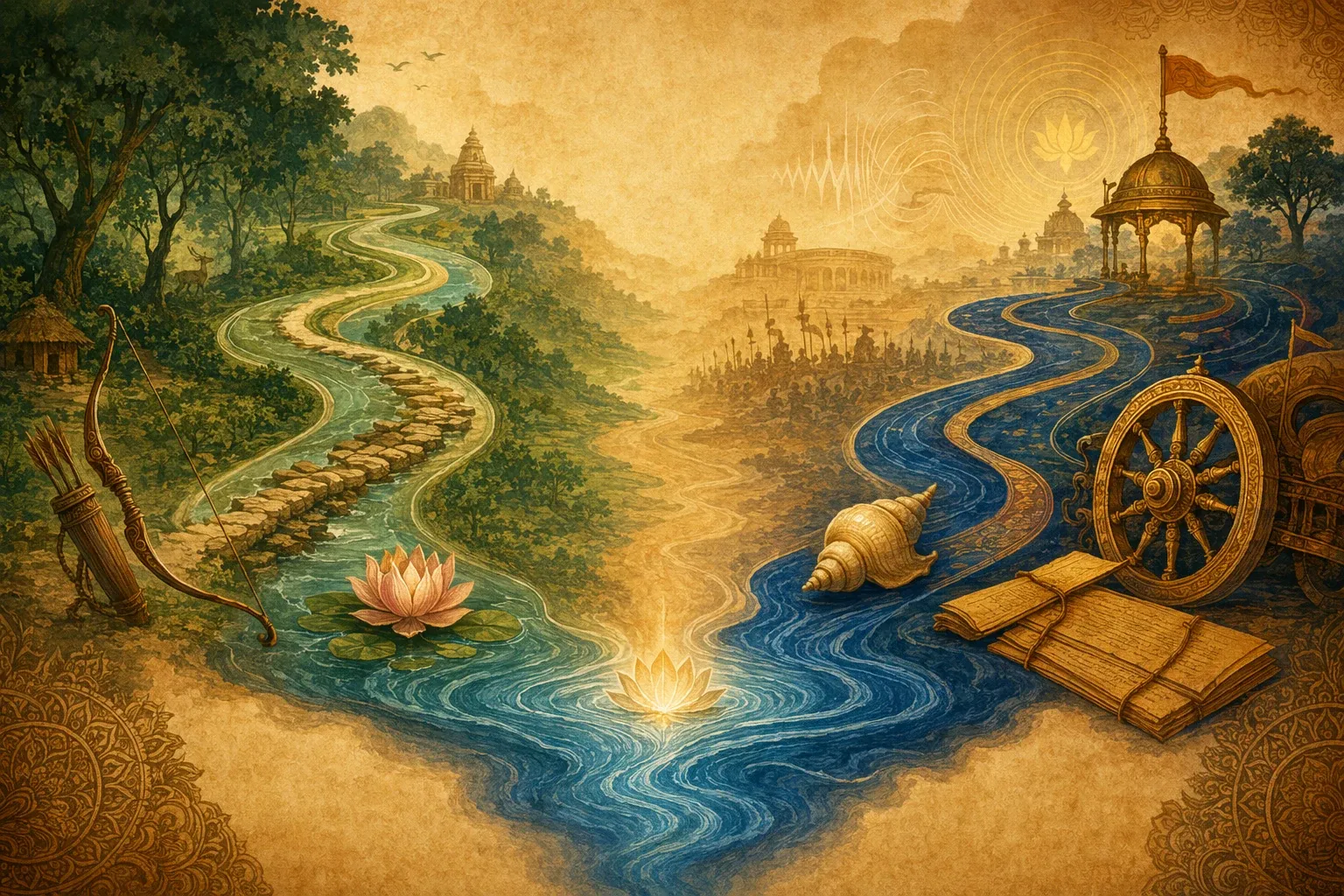
If you searched for 'ramayana vs mahabharata', this beginner-friendly Bhaktilipi guide is for you.
Reader questions behind this guide: What is the difference between Ramayana and Mahabharata?; Who wrote Ramayana and Mahabharata?; Which is older, Ramayana or Mahabharata?.
We will keep the explanation simple, respectful, and useful, while clearly separating tradition, interpretation, and modern historical discussion where needed.
Quick answer
The Ramayana mainly tells the story of Rama, Sita, exile, Ravana, and the rescue of Sita. The Mahabharata mainly tells the story of the Kuru family, the Pandavas, the Kauravas, Krishna, and the Kurukshetra war.
A simple difference: the Ramayana often shows dharma through an ideal hero trying to uphold duty, while the Mahabharata shows dharma in a complex world where every choice feels tangled.
Story and main heroes
In the Ramayana, the central figures include Rama, Sita, Lakshmana, Hanuman, Bharata, and Ravana. The story moves from Ayodhya to forest exile to Lanka and back.
In the Mahabharata, the central figures include the Pandavas, Kauravas, Krishna, Draupadi, Bhishma, Karna, Drona, and many others. Its world is larger, with many sub-stories and philosophical conversations.
Valmiki and Vyasa traditions
The Ramayana is traditionally attributed to Maharishi Valmiki. The Mahabharata is traditionally attributed to Maharishi Vyasa.
Both attributions are central to Indian tradition. At the same time, both epics reached us through long processes of oral transmission, manuscript copying, commentary, and retelling.
Dharma lessons in each epic
The Ramayana often asks: how does a person keep promises, honour relationships, and protect righteousness even in suffering?
The Mahabharata often asks: what should one do when every option has pain, politics, duty, and moral conflict mixed together? It includes the Bhagavad Gita, where Krishna teaches Arjuna about action, duty, and wisdom.
Which is older?
Traditionally, the Ramayana is associated with Treta Yuga and the Mahabharata with Dvapara Yuga. In that sacred timeline, the Ramayana comes earlier.
Modern academic dating is more complicated and debated. Beginners should avoid pretending that one exact date settles everything.
Which one should beginners read first?
If you want a clearer heroic story, start with a simple Ramayana retelling. If you enjoy complex family politics, philosophy, and many characters, begin with a beginner Mahabharata guide.
Ideally, read both slowly. Together, they show why Indian civilisation thinks so deeply about dharma, karma, family, power, truth, and responsibility.