
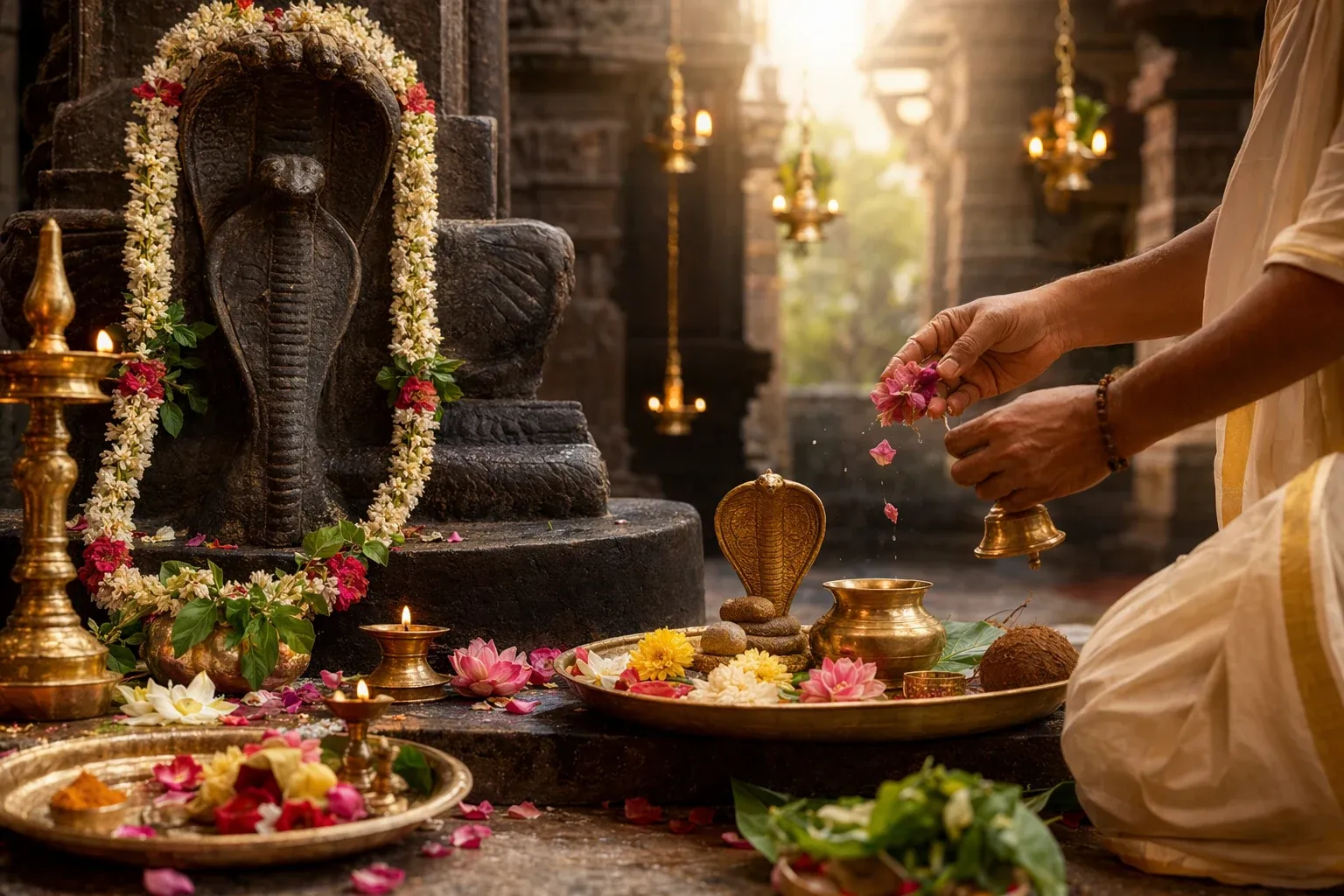
Sarpa Samskara Pooja is a temple ritual connected with serpent worship, especially in the tradition of Kukke Sri Subrahmanya in Karnataka. People usually ask about it because they have heard words such as sarpa dosha, naga dosha, family obstacles, or prayers for children. A calm way to understand it is this: devotees approach the ritual as an act of repentance, reverence, and prayer connected with nagas, not as a guaranteed solution that anyone should be frightened into performing.
What Sarpa Samskara means
To understand why samskara can mean a rite or refinement in different contexts, read What Is Samskara? Meaning in Hinduism, Yoga, and Daily Life.
Sarpa means serpent. Samskara can mean a rite, refinement, or purifying ceremony, depending on context. In this ritual context, Sarpa Samskara refers to a prescribed religious observance for serpent-related concerns. The best-known public association is Kukke Sri Subrahmanya Temple, where Lord Subrahmanya is worshipped in close connection with the divine serpent Vasuki and naga tradition.
The ritual is often described as a seva, meaning an offering of worship performed according to temple custom. It is not the same as the general Hindu life-cycle samskaras such as naming, initiation, marriage, or funeral rites. Here the word samskara is being used in a more specific ritual sense: a formal religious act meant to acknowledge, purify, and seek peace around a particular concern.
Why devotees perform it
In traditional belief, Sarpa Samskara is performed when a family feels connected to serpent-related karma, harm done knowingly or unknowingly to snakes, ancestral unrest, or obstacles described by priests or astrologers as sarpa dosha or naga dosha. Some devotees also approach it while praying about marriage delays, family disharmony, health anxieties, financial obstacles, or difficulty having children.
These are matters of faith and family tradition. They should be presented that way. A respectful article should not claim that the ritual certainly removes every problem, cures illness, guarantees pregnancy, or changes destiny on demand. Devotees may sincerely feel peace after worship, and temple traditions may describe spiritual benefits, but those experiences are not the same as medical or scientific proof.
Why serpents matter in this tradition
Serpents have an important symbolic place in many Hindu traditions. Nagas appear in temple worship, mythology, sacred geography, and protective symbolism. They can represent hidden power, fertility, protection, the earth, water sources, and ancestral continuity. At Kukke, the temple’s own public description emphasizes Lord Subrahmanya’s association with serpents and the site’s reputation for naga-related worship.
This symbolic background helps explain why a serpent-related ritual may feel meaningful to devotees. It is not simply “snake fear.” For many families, it is a way to express remorse for harm, honor life, remember ancestral responsibility, and ask for harmony. Seeing that wider context prevents the topic from becoming sensational.
What usually happens around the ritual
Details differ by temple, priestly instruction, family custom, and current temple rules. At Kukke, Sarpa Samskara is generally understood as a structured seva rather than a casual one-minute prayer. Public booking information and temple-related guides describe it as a formal observance with dress expectations, reporting times, and participation rules. Devotees should always rely on the official temple channel or temple office for current details, not on random social-media claims.
It is also wise to separate ritual explanation from logistics. The meaning of the pooja is devotional and symbolic. The practical side—fees, slots, ID proof, accommodation, timings, and rules—can change. Anyone considering it should verify directly with the temple or an authorized source before making travel plans or payments.
Pregnancy, children, and family concerns
Many searches ask how Sarpa Samskara is related to pregnancy. The connection is traditional, not clinical. In some families, the ritual is performed when people are praying for progeny or when astrologers connect repeated difficulty with sarpa dosha. That does not mean the ritual should replace medical care, fertility evaluation, counseling, or healthy communication within the family.
A balanced approach is simple: if a family wishes to perform the ritual as a matter of faith, they can do so without shame. At the same time, no one should be pressured, blamed, or frightened—especially a woman or couple facing fertility struggles. Faith practices can offer emotional support, but they should not become a way to assign guilt or avoid professional help when needed.
How to approach Sarpa Samskara respectfully
First, treat it as a living tradition. Avoid mocking people who perform it, and avoid selling it as a magical shortcut. Second, use careful language: “devotees believe,” “temple tradition holds,” and “families may perform” are more honest than absolute claims. Third, check practical information with official temple sources, because pilgrimage details can change.
Fourth, be alert to fear-based marketing. If someone says that terrible things will definitely happen unless money is paid immediately, that is a warning sign. A sincere priest or temple system should be able to explain the practice calmly, including what is required and what is optional. Devotion does not need panic to be meaningful.
What Sarpa Samskara is not
It is not a universal duty for every Hindu. It is not a medical treatment. It is not a guaranteed fix for marriage, pregnancy, finance, health, or family conflict. It is not something a person must perform because an internet post made them afraid. It is a specific ritual in specific traditions, approached by devotees for specific reasons.
It is also not the same as ordinary respect for snakes or nature. Someone may honor naga symbolism, avoid harming animals, support ecological care, and still never perform this particular seva. Conversely, a devotee may perform the pooja as part of inherited faith while also living responsibly toward animals, land, and family.
A grounded way to remember it
Think of Sarpa Samskara in three layers. The religious layer is worship of Lord Subrahmanya and naga-related tradition. The moral layer is repentance, humility, and respect for life. The emotional layer is the family’s wish for peace when they feel burdened by obstacles. These layers help explain why the ritual matters to devotees without turning belief into pressure.
For a beginner, the safest summary is: Sarpa Samskara Pooja is a traditional serpent-related temple ritual performed by devotees seeking spiritual peace around naga dosha, ancestral concerns, or family obstacles. It deserves respect, careful sourcing, and non-fearful explanation.
FAQs
What is Sarpa Samskara Pooja?
It is a specific Hindu temple ritual connected with serpent or naga-related concerns, especially associated in public memory with Kukke Sri Subrahmanya Temple. Devotees perform it as an act of worship, repentance, and prayer.
Why is Sarpa Samskara performed?
In tradition, it is performed for concerns described as sarpa dosha or naga dosha, ancestral issues, or family obstacles. These are devotional beliefs, so they should be explained respectfully without promising guaranteed results.
Is Sarpa Samskara related to pregnancy?
Some families connect the ritual with prayers for children or relief from obstacles to progeny. This is a matter of faith and should not replace medical advice, fertility care, or compassionate family support.
Should everyone perform Sarpa Samskara?
No. It is not a universal requirement. Anyone considering it should speak with trusted family elders, a reliable priest, and official temple sources, and should avoid decisions driven by fear or pressure.