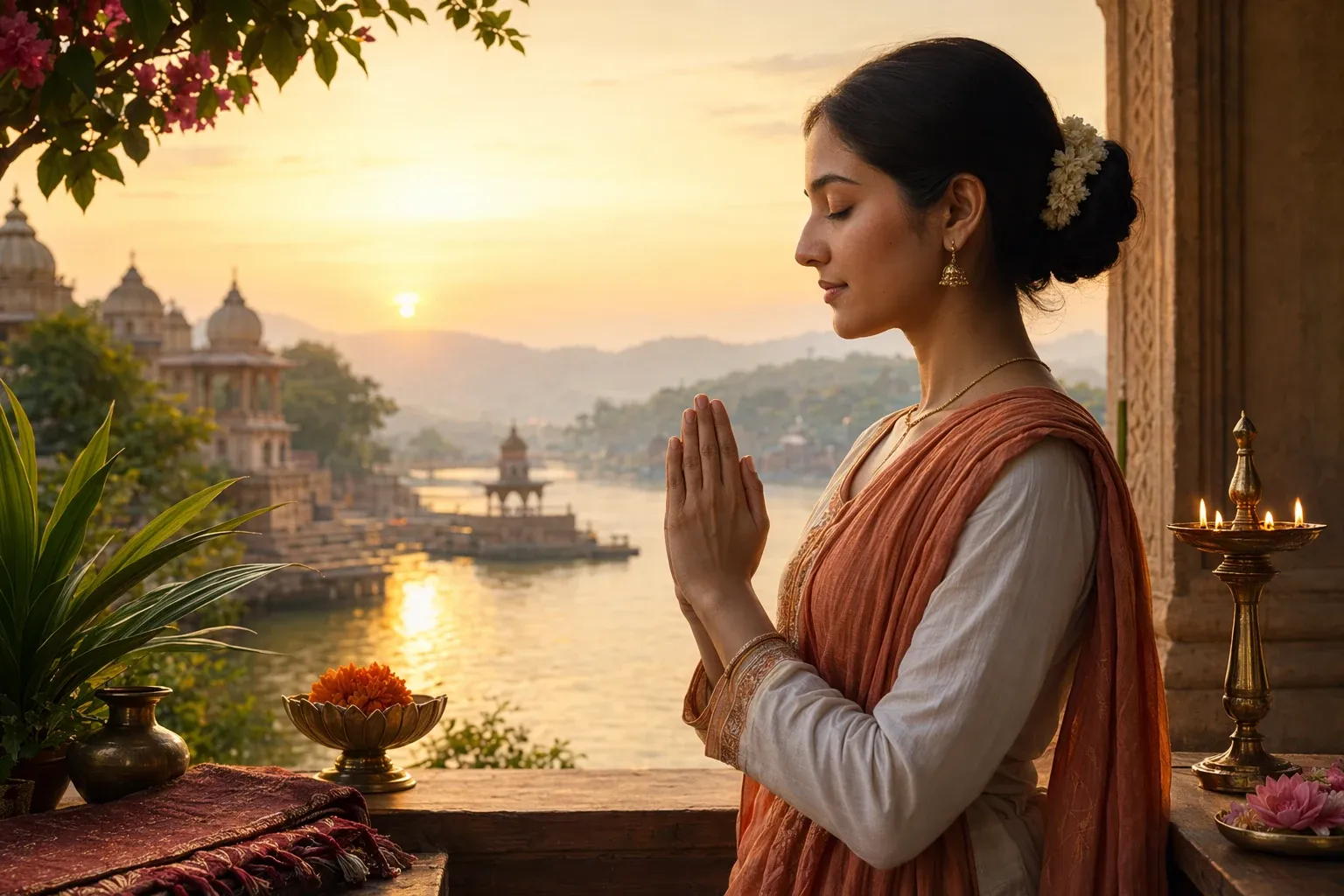
Namaste is a respectful Indian greeting made with folded hands, a slight bow, and the spoken word “namaste.” In everyday life it can simply mean hello, welcome, or respectful goodbye. In a spiritual sense, it carries a deeper feeling: I honour the sacred presence, dignity, or inner light in you.
That deeper meaning is why many people connect Namaste with humility, devotion, yoga, meditation, and Indian cultural etiquette. It is not a magic formula, and it should not be treated as a fashionable slogan. At its best, Namaste is a small gesture that reminds both people to meet with respect rather than ego.
What does Namaste literally mean?
Namaste is commonly explained through Sanskrit: “namas” means bowing, reverence, or respectful salutation, and “te” means to you. A simple literal meaning is “I bow to you” or “salutations to you.” The word is related to a family of respectful expressions used in Indian languages and religious settings.
The literal meaning matters because it keeps the greeting grounded. Namaste is not just about sounding spiritual. It is about the act of offering respect.
The spiritual idea behind Namaste
The spiritual meaning often shared is: the divine in me honours the divine in you. Different teachers express this in different words. Some say inner light, some say soul, some say sacred presence, some say the Self. The exact language may change, but the central idea is similar: every person deserves reverence because there is more to them than body, status, wealth, or social identity.
This does not mean you must believe one specific doctrine to use the greeting. In a broad cultural sense, Namaste can simply remind us that another person is not an object or obstacle. They are a living being worthy of care.
Why folded hands matter
Namaste is usually made with palms joined near the chest. This hand position is often called Anjali Mudra in yoga and Indian art contexts. The joined palms suggest unity, focus, humility, and offering. Instead of pointing outward or grabbing, the hands come together. The body becomes quieter.
A slight bow adds another layer. Bowing lowers the ego. It says, in body language, “I meet you with respect.” The gesture can be used in homes, temples, classical arts, yoga spaces, and social gatherings.
For more on related hand gestures, see Anjali, Dhyana, and Abhaya Mudra.
Is Namaste religious?
Namaste can be religious, spiritual, cultural, or simply polite depending on context. In a temple, it may feel devotional. In a yoga class, it may feel reflective. At home, it may be a respectful greeting to elders or guests. In public life, it may be a courteous Indian greeting.
Because the word moves across many settings, it is better not to force one narrow meaning on it. A grandmother greeting a visitor, a dancer saluting an audience, and a yoga teacher closing a class may all use Namaste, but the emotional tone can differ.
Namaste and humility
One of the most beautiful meanings of Namaste is humility. The gesture does not demand attention. It does not try to dominate the other person. It asks you to pause, gather yourself, and greet with awareness.
In a fast conversation, we often react from habit. Namaste slows the moment. It can remind us to speak gently, listen better, and remember that respect should come before argument.
Namaste in yoga and meditation
In many yoga spaces, Namaste is spoken at the beginning or end of practice. Ideally, it is not used as a decoration. It should be explained with care, especially outside India, so students know that the word belongs to living cultural and spiritual traditions.
When used thoughtfully, Namaste can close a practice with gratitude: gratitude to the teacher, the body, the breath, fellow students, and the discipline itself. If used casually without understanding, it can feel empty.
Beginners may also like how to start yoga at home for a broader foundation.
Common misunderstandings
Namaste does not mean “the god in me is better than you.” It is not a ranking. It is not a secret password. It is not only for yoga studios. It is also not a costume word that should be printed on everything without thought.
Another misunderstanding is that every Indian person uses Namaste in exactly the same way. India has many languages and greetings: Namaskar, Pranam, Vanakkam, Sat Sri Akal, Ram Ram, Jai Shri Krishna, and many others. Namaste is widely recognised, but it is part of a larger greeting culture.
How to use Namaste respectfully
Use it with sincerity. Join the palms gently, bow slightly if appropriate, and avoid exaggeration. In Indian family or temple settings, observe how others greet. If you are outside India, do not use the word as a joke or decorative catchphrase. If you teach yoga or meditation, explain its meaning rather than rushing through it.
The simple takeaway is this: Namaste means respectful salutation, and its spiritual meaning points toward humility and recognition. It asks us to see the other person with dignity. That small act can make an ordinary greeting feel thoughtful, calm, and sacred.
A modern way to understand it
In modern life, Namaste can be a pause before habit takes over. It asks you to greet the person in front of you, not their job title, clothing, accent, or social position. That is why the greeting still feels powerful in families, classrooms, temples, and reflective spaces. It is small enough for daily use but deep enough to remind us that respect is a practice.
If you use Namaste outside India, let it remain simple. Learn its roots, say it clearly, and allow the gesture to make you more attentive rather than more performative.