
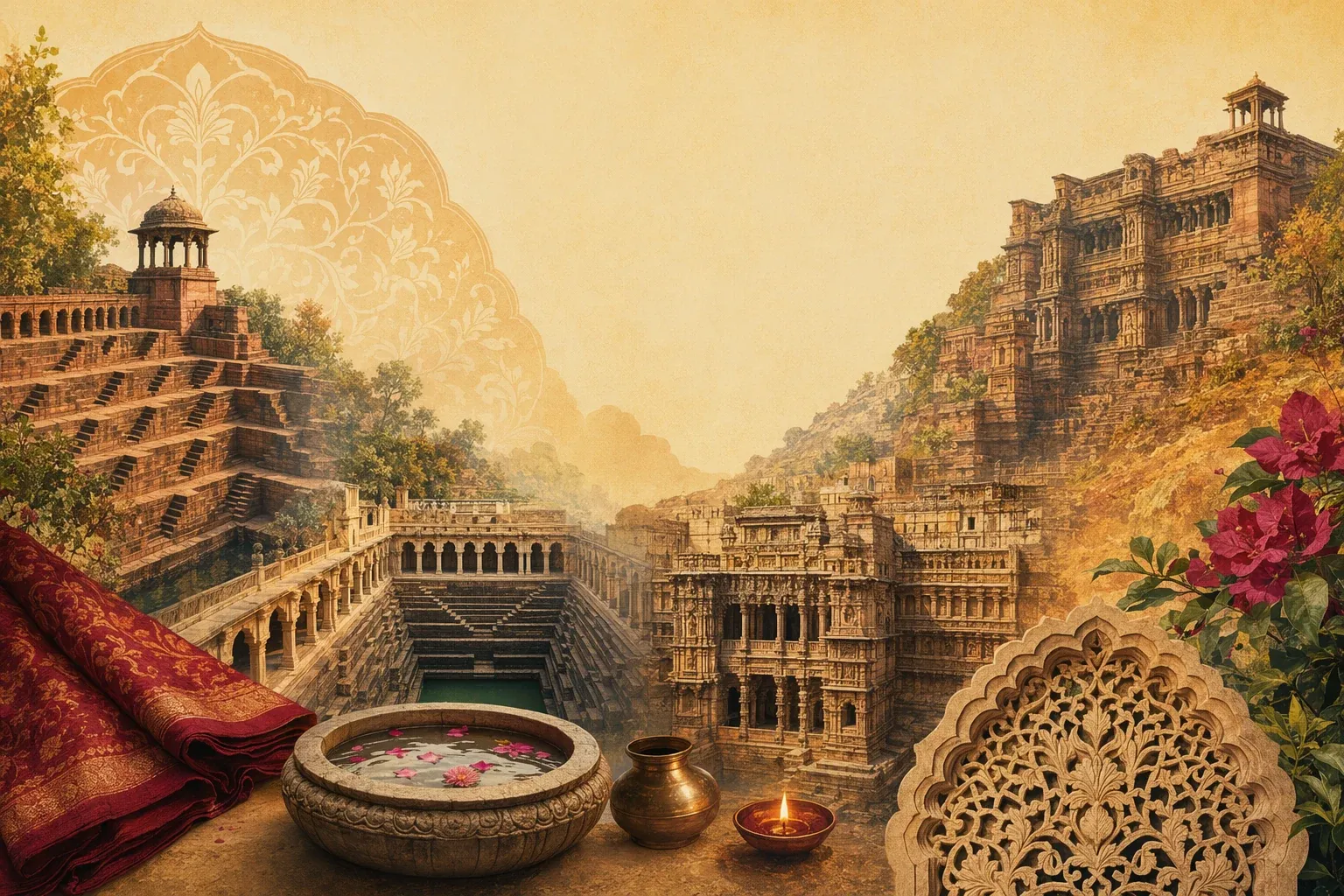
Stepwells are called by many names in India. The most familiar English word is stepwell, but on the ground people may say baoli, baori, bawdi, baudi, bawri, vav, vaav, kalyani, pushkarani, or barav depending on the region and language. These are not just spelling variations. They are small windows into how different communities understood water, architecture, and daily life.
A reader may first meet the word stepwell in a textbook or travel video. Then the same kind of structure appears as Agrasen ki Baoli in Delhi, Chand Baori in Rajasthan, or Rani ki Vav in Gujarat. At first this feels confusing. Why does one monument have baoli, another baori, and another vav? The simple answer is that India’s water heritage grew in many languages, not in one central vocabulary.
The English word: stepwell
Stepwell is a useful modern English umbrella term. It usually means a well, cistern, pond, or reservoir reached by steps. The key feature is descent. Instead of standing at a well mouth and pulling water only from above, people can walk down through steps, landings, corridors, or galleries toward the water level.
This word is helpful for comparison. It lets a student connect Chand Baori in Rajasthan, Rani ki Vav in Gujarat, and Agrasen ki Baoli in Delhi as members of a larger family. But it can also flatten local differences. A Gujarati vav, a Rajasthani baori, and a Delhi baoli may share the idea of stepped access to water, while still differing in plan, stonework, patronage, sacred imagery, and local memory.
Baoli, baori, bawdi, and baudi
In north Indian and Hindi-speaking contexts, baoli is common. Delhi’s Agrasen ki Baoli is a famous example. The word appears with several spellings because Indian words move across scripts, dialects, and English transliteration. You may see baoli, baori, bawdi, baudi, bawri, bawari, or bavdi. These forms are related in usage, but local speakers may prefer one over another.
In Rajasthan, baori or bawdi is often heard. Chand Baori at Abhaneri carries that name. Rajasthan Tourism describes Chand Baori as a stepwell built for conserving water and providing relief from intense heat, with 3,500 narrow symmetrical steps and a three-sided descent toward the water. The word baori here does more than label a monument. It places the structure inside a dry-region memory of practical water wisdom.
Vav and vaav in Gujarat
In Gujarat, the word vav or vaav is central. Rani ki Vav at Patan is the most famous example for many readers. Gujarat Tourism describes it as a stepwell on the banks of the Saraswati River, with multiple levels, carved pillars, more than 800 sculptures, and an inverted-temple form. The name itself tells you that you are in Gujarat’s vocabulary of water architecture.
Adalaj ni Vav, also known as the Adalaj Stepwell or Rudabai Stepwell, is another well-known Gujarati example near Gandhinagar. Its name carries the same regional clue. When we say vav instead of only stepwell, we allow the local language to remain visible. That matters in heritage writing because monuments are not only stone objects; they are also names remembered by communities.
Kalyani, pushkarani, and related water structures
Some words, such as kalyani or pushkarani, are often connected with temple tanks or sacred stepped water bodies, especially in parts of south India. They may not always match the long corridor-and-shaft form that many people imagine when they hear stepwell. Still, they belong to the wider Indian habit of designing water access through steps, platforms, and ritual space.
This is where careful language helps. Every stepped water body is not automatically the same type of stepwell. A temple tank may have steps on all sides. A baoli may descend toward a shaft. A vav may be a long, multi-level structure with sculptural galleries. A johad may be an earthen rainwater-harvesting structure rather than a stepped well. Good heritage learning notices both similarity and difference.
Why the names changed by region
India’s geography is varied, and so are its languages. Water structures in arid Gujarat and Rajasthan developed under different rainfall patterns, stone traditions, royal patronage, trade routes, and settlement needs. The names grew from local speech. As these words entered English writing, spellings changed again because Devanagari, Gujarati, Marathi, Kannada, and other scripts do not map perfectly into Roman letters.
That is why baori and bawri may refer to the same broad family in everyday writing. It is also why vav and vaav both appear. The goal is not to panic over one correct English spelling in every case. The better goal is to identify the local term used for a specific monument, and then explain it clearly for readers.
Names also show how people used the structure
A name can reveal social life. Baoli may bring to mind old Delhi lanes, protected monuments, and urban memory. Baori may suggest Rajasthan’s dry landscapes, village water points, and dramatic geometry. Vav may call up Gujarat’s sculptural architecture, from Patan to Adalaj. These associations are not rigid rules, but they help readers feel that water heritage was lived, not just designed.
Stepwells were often built for practical access to water. Many also became cool spaces, meeting points, resting places, sacred settings, or markers of local generosity. A name carried through generations can preserve that relationship. Even when the structure is no longer used for daily water, the word remains part of cultural memory.
Famous examples and their names
Rani ki Vav means the queen’s vav, and the Patan monument is traditionally associated with Queen Udayamati of the Chaulukya period in memory of Bhimdev I. The historical tradition is important, while exact details should still be handled through inscriptions, texts, archaeology, and responsible sources. Chand Baori at Abhaneri is often linked with King Chanda of the Nikumbha dynasty, but some sources note that direct epigraphic evidence is limited, so careful writers avoid overconfidence.
Agrasen ki Baoli in New Delhi is another useful example. It is a protected monument on Hailey Road, and public descriptions often connect it with Agrasen tradition while also noting uncertainty around original construction. The name baoli helps locate it in Delhi’s vocabulary, but the history still deserves caution.
What should students remember?
The easiest way to remember the terms is this: stepwell is the English umbrella word; baoli, baori, bawdi, and similar forms are common in north and north-west India; vav or vaav is especially associated with Gujarat; kalyani and pushkarani often refer to stepped temple tanks or sacred water bodies in other regions. These words overlap in popular usage, but they are not meaningless decorations.
When you see the local name, respect it. Say Chand Baori, not only Chand Stepwell. Say Rani ki Vav, not only Queen’s Stepwell. That small choice keeps language, place, and community attached to the monument.
Questions people ask
Stepwells are also called?
Stepwells are also called baoli, baori, bawdi, baudi, bawri, vav, vaav, and sometimes related terms such as kalyani, pushkarani, or barav depending on region and structure.
What are stepwells called in Rajasthan?
In Rajasthan, stepwells are often called baori, bawdi, or related spellings. Chand Baori at Abhaneri is one of the best-known examples.
What are stepwells called in Gujarat?
In Gujarat, stepwells are commonly called vav or vaav. Rani ki Vav at Patan and Adalaj ni Vav near Gandhinagar are famous examples.
What is another name for a stepwell?
Another name for a stepwell is baoli or baori in many north Indian contexts, and vav in Gujarat. The best name depends on the monument’s region and local language.
A respectful way to use the words
Heritage writing should make readers comfortable without erasing local texture. It is fine to begin with “stepwell” for clarity. But once the place is known, use its own name. Rani ki Vav, Chand Baori, Agrasen ki Baoli, and Adalaj ni Vav all teach the same lesson: India’s water systems were practical, artistic, and deeply regional.
These names remind us that culture lives in vocabulary. Water was not just stored; it was named, shared, protected, and remembered. The steps went down to water, but the names carry us back into the minds of the people who built and used them.