
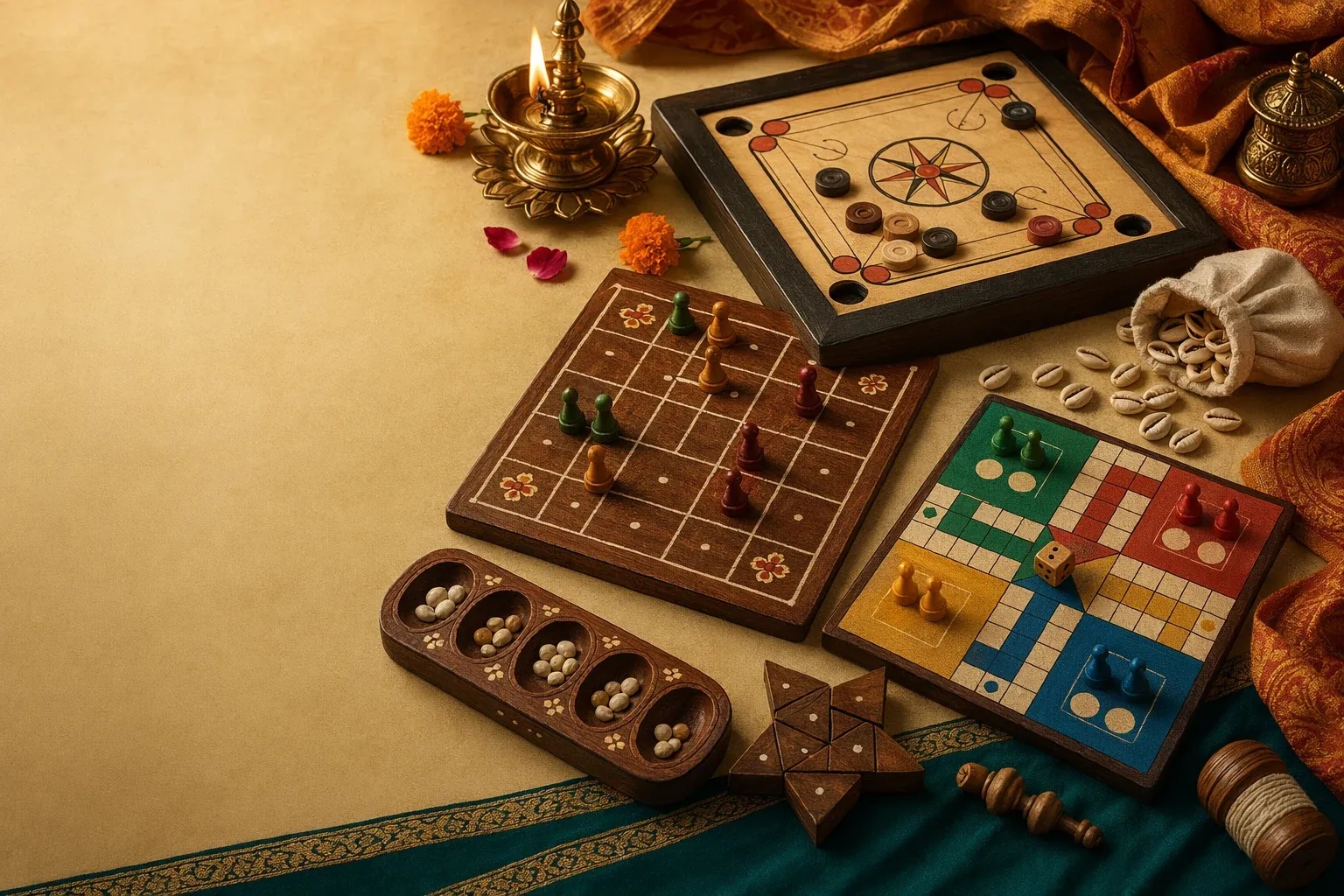
Traditional Indian board games are not only a list of old names. They are a doorway into how people played, counted, argued, taught children, imagined battle, explored fate, and turned moral lessons into memorable boards. Some games are deeply old in memory. Some are better documented in medieval or early modern forms. Some became household favourites in the modern period. For beginners, the best list is not a product ranking. It is a culture-first map.
This guide introduces major names you are likely to meet: Chaturanga, Pachisi, Chaupar, Gyan Chauper, Carrom, and a few related families of Indian-style tabletop play. The aim is simple: know what each game broadly is, what makes it culturally important, and what caution to keep in mind when someone makes a very confident claim about its age or origin.
Chaturanga: strategy on a battlefield board
Chaturanga is one of the most famous Indian names in world board-game history. The word caturaṅga means four-limbed or four-part, and it is connected with the idea of a fourfold army: elephants, chariots, cavalry, and infantry. This makes the game more than a puzzle. It reflects how strategy, formation, rank, and movement could be imagined on a board.
Chaturanga is widely discussed as an ancestor within the chess family, though historians remain careful about exact early rules. The game is important because it shows a strong Indian tradition of thinking through position and consequence. A player must look beyond one move, protect key pieces, and understand how small choices shape the whole field.
Pachisi: movement, cowries, and social play
Pachisi is a cross-shaped race game associated with cowrie-shell throws and movement of pieces around a board. Its name is linked with paccīs, meaning twenty-five, a high throw in a common form. The game blends chance and judgement. The throw gives possibility; the player chooses how to use it.
Pachisi is culturally important because it is social. It can be played on cloth, on a drawn board, or in more formal material versions. It invites conversation, rivalry, teasing, and patience. Modern Ludo belongs to the wider family of similar movement games, but traditional Pachisi has its own texture and should not be treated as only an old version of a plastic-board game.
Chaupar: a closely related classic
Chaupar is closely related to Pachisi in popular understanding, and many readers meet the two names together. It is often imagined with a cross-shaped layout, pieces, and throws that determine movement. In Indian cultural memory, Chaupar-like play is also linked with royal, epic, and domestic settings.
The careful point is this: names and rules can vary by region and period. What one family calls Chaupar may not match another family’s exact rules. That variation is normal in traditional games. Oral teaching, local habits, available materials, and family memory all shape how a game survives.
Gyan Chauper: when a game becomes a moral journey
Gyan Chauper, also spelled Gyan Chaupar, is important because it connects play with moral and spiritual teaching. In later global memory, it is connected with Snakes and Ladders. The basic idea is easy to understand: upward movement can be linked with virtues, while downward movement can be linked with faults, attachments, or harmful tendencies.
This game should be handled respectfully. Different religious and regional forms existed, including Jain examples with their own structure and symbolism. It is not just a children’s race to the finish. At its deeper level, it can teach that actions have consequences, that pride or greed can pull a person down, and that liberation or higher understanding requires more than luck.
Carrom: the familiar tabletop favourite
Carrom may not feel ancient in the same way as Chaturanga or Pachisi, but it is one of the most familiar tabletop games in Indian and South Asian life. Players use a striker to flick small discs toward corner pockets. It needs aim, angle, touch, focus, and emotional steadiness. A careless shot can scatter the board; a calm shot can change the game.
Carrom became popular in homes, clubs, hostels, and community spaces because it is compact and social. Children can learn the basics quickly, while skilled players can spend years improving. Its organized modern form includes formal rules and federations, but its emotional home is often a family room or neighbourhood club.
Ashtapada and square-board memory
Ashtapada is another name beginners may see while reading about early Indian board games. It is associated with an eight-by-eight board in discussions of early game history and chess-related traditions. The exact relationship between named boards, pieces, and rule systems can be difficult, so it is best to treat Ashtapada as part of the background landscape rather than making unsupported claims.
Its importance is still real. Square boards help us understand how Indian players and thinkers used grids for movement, calculation, and symbolic order. A grid is simple, but once pieces are added, it becomes a world of paths, blocks, threats, and choices.
Regional mancala-style and counting games
India also has traditional counting games played with pits, seeds, shells, or counters, often known by regional names. In South India, Pallankuzhi or Ali Guli Mane-type games are familiar examples in wider Indian play culture. These are not always called board games in the same way as chess or Pachisi, but they use a board-like object and teach counting, distribution, memory, and planning.
Such games remind us that Indian tabletop play was not limited to royal or text-heavy traditions. It also belonged to kitchens, courtyards, festivals, and children’s learning. The materials could be simple, but the mental work was real.
Modern Indian-themed tabletop games
Today, many creators design new board games using Indian history, mythology, festivals, wildlife, cities, trade, kingdoms, and storytelling. These games are not traditional in the old sense, but they can still be culturally meaningful when they are made with research and respect. A game about an epic journey, a temple town, a spice route, or a craft tradition can help new learners enter culture through play.
The caution is important: Indian themes should not become shallow decoration. If a game uses deities, epics, sacred symbols, caste history, tribal communities, or living rituals, it should do so carefully. Fun and respect can exist together.
How to choose a game for beginners
If you want strategy, begin with chess and learn about Chaturanga as historical background. If you want family laughter and movement, choose Pachisi, Chaupar, or a Ludo-like game while remembering the older family of play. If you want moral symbolism, explore Gyan Chauper through reliable explanations. If you want quick skill-based competition at home, choose Carrom. If you want counting practice for children, look at regional seed-and-pit games.
Also ask practical questions. How many players are needed? Can children understand the rules? Is the board legally sold or ethically reproduced? Are cultural symbols explained respectfully? Does the game encourage patience rather than only winning? These questions matter more than buying the fanciest board.
Questions people ask
What are the five traditional games played in India?
A board-game focused answer could include Chaturanga, Pachisi, Chaupar, Gyan Chauper, and Carrom. If outdoor games are included, names like Kabaddi, Kho-Kho, Gilli-Danda, and Lagori may also appear, but they belong to a different category.
What are the Indian board games famous?
Chaturanga is famous for chess history, Pachisi and Chaupar for race-game culture, Gyan Chauper for moral symbolism, and Carrom for modern household popularity across South Asia.
What is the popular board game in India?
Carrom, chess, and Ludo-like games are very familiar in modern India. For traditional cultural history, Pachisi/Chaupar and Chaturanga are especially important names.
A culture-first way to remember the list
Do not memorise these games as dead museum labels. Remember what each one teaches. Chaturanga teaches strategy. Pachisi and Chaupar teach movement, chance, and social judgement. Gyan Chauper teaches moral consequence. Carrom teaches skill, focus, and friendly competition. Regional counting games teach memory and number sense. Together, they show that Indian play culture has always been clever, social, and full of meaning.