The phrase “eight auspicious symbols” sounds simple, but it needs context. Hindu, Jain, and Buddhist traditions do not always use the same lists in the same way. Some symbols overlap, some are tradition-specific, and some change meaning depending on region, ritual, art, and community memory.
So the safest beginner answer is this: do not treat one universal list as if it belongs equally to every Indian religion. Learn the context first, then learn the symbols. That approach is more accurate and more respectful.
Why auspicious symbols matter
Auspicious symbols are visual reminders of blessing, protection, wisdom, purity, prosperity, victory, spiritual progress, or good beginnings. They appear in temples, homes, manuscripts, festival decoration, paintings, textiles, jewellery, architecture, and pilgrimage spaces.
They work like cultural memory tools. A lotus may remind one person of purity, another of Lakshmi or Saraswati, another of Buddhist awakening, and another of Jain temple art. Meaning depends on the tradition using it.
Buddhist eight auspicious symbols
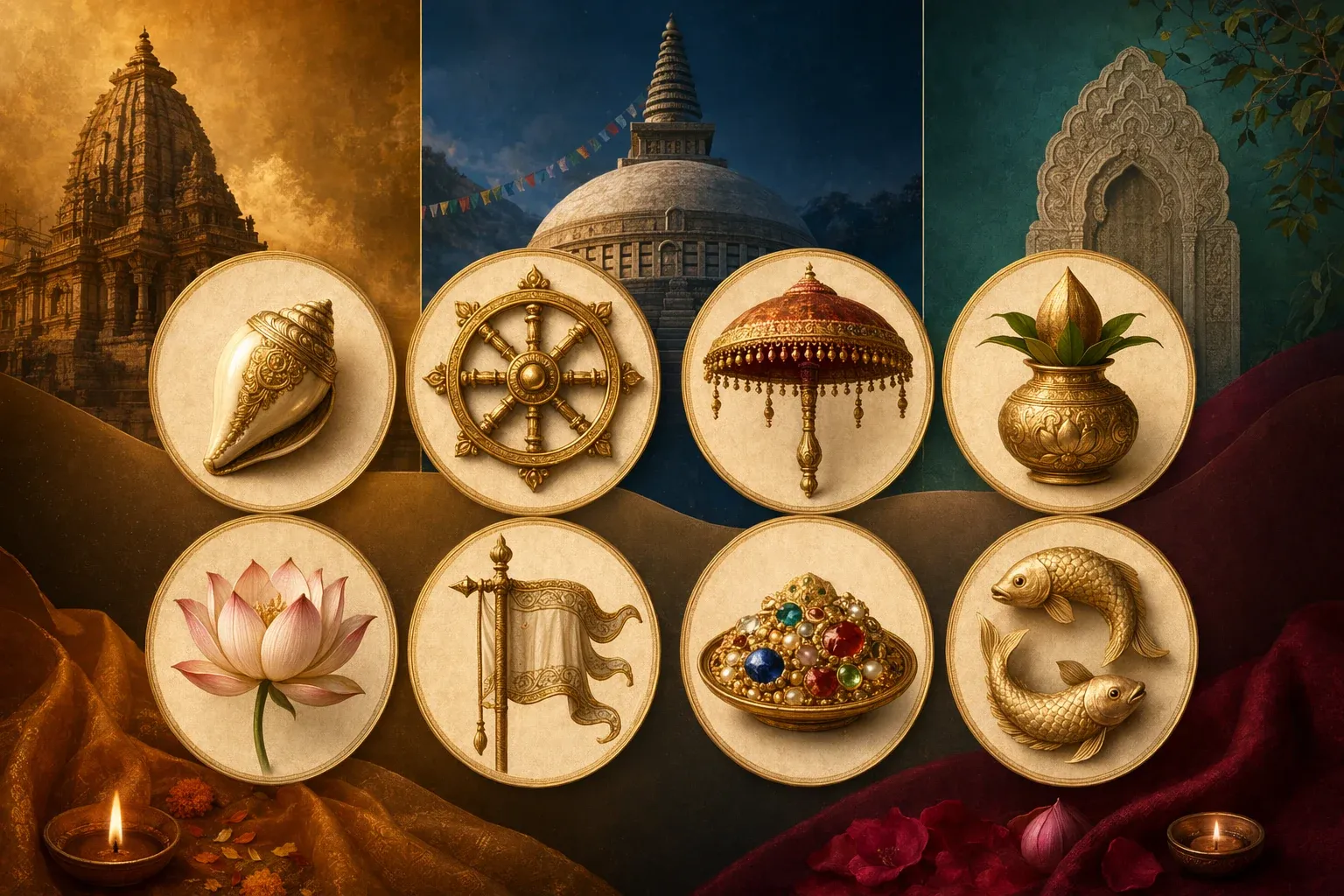
Many people know the Buddhist Ashtamangala list: parasol, pair of golden fish, treasure vase, lotus, conch, endless knot, victory banner, and dharma wheel. This list is especially visible in Tibetan and Himalayan Buddhist art, though meanings and artistic forms vary.
These symbols are not just decorative stickers. They point toward ideas such as protection, wisdom, abundance, purity, spiritual teaching, interdependence, victory over obstacles, and the turning of the Dharma. A beginner should learn the list as part of Buddhist art and practice, not as a generic wellness graphic.
Jain auspicious symbols
Jain traditions also use auspicious symbols, including Ashtamangala sets in ritual and temple contexts. Lists and visual forms can vary by community and region. Jain symbolism often connects with purity, right faith, right knowledge, right conduct, reverence for Tirthankaras, and the path toward liberation.
Jain symbols should be read through Jain meaning, not borrowed casually from a Buddhist or Hindu chart. If you are new to Jain basics, start with our Jainism beginner guide and our guide to ahimsa, karma, and moksha in Jainism.
Hindu auspicious symbols
Hindu traditions use many auspicious signs, but not always as one single fixed “eight symbols” list for everyone. Common symbols include Om, swastika in its sacred Indian meaning, lotus, conch, kalasha, lamp, trishul, tilak, rudraksha, cow, elephant, and footprints of deities, depending on context.
The number eight can appear in Hindu settings too, such as ashta ideas, eight forms, eight directions, or eight blessings. But beginners should not force a Buddhist Ashtamangala list onto every Hindu ritual. Our Hindu symbols guide explains this wider symbolic language.
Why lists differ
Lists differ because traditions are living, not spreadsheet categories. A symbol used in a temple may differ from a symbol used in a marriage ritual, monastery painting, manuscript margin, home doorway, festival rangoli, or pilgrimage flag. Regional art also changes how symbols are grouped and drawn.
This is why overconfident social media posts can mislead. A neat graphic may look educational but mix Hindu, Jain, and Buddhist meanings without warning. A beginner should ask three questions: Which tradition is this from? Which region or community uses it? What does the symbol mean in that specific setting?
How to compare without mixing
A useful way to compare is to make three columns: Buddhist context, Jain context, and Hindu context. Put each symbol under the tradition where you are actually studying it. If the same object appears in more than one column, write the meaning separately instead of assuming it is identical.
This method protects both accuracy and devotion. It lets you notice shared Indian artistic language while still respecting each tradition’s theology, ritual use, and community memory.
How to use symbols respectfully
Sacred symbols deserve thoughtful placement. Avoid using them as jokes, on dirty objects, in disrespectful fashion placement, or as random exotic decoration. If you use a symbol in art, study the meaning and mention the tradition honestly.
Respect also means not claiming that one tradition “copied” another just because symbols overlap. India’s religious history includes debate, sharing, adaptation, parallel development, and regional creativity. Overlap is not automatically theft, and difference is not automatically conflict.
What beginners should remember
The eight auspicious symbols are best understood through context. Buddhism has a well-known Ashtamangala set. Jain traditions have their own auspicious symbol usage. Hindu traditions have a wide world of auspicious signs and may not follow one universal eight-symbol list. Learn the tradition, then learn the symbol. That keeps curiosity accurate and respectful.
A beginner-friendly way to remember
Remember the Buddhist list first as a Buddhist list: parasol, fish, vase, lotus, conch, endless knot, victory banner, and wheel. Then separately learn Jain auspicious symbols from Jain sources and Hindu auspicious symbols from Hindu ritual or temple contexts. This prevents one tradition’s list from swallowing the others.
If a symbol appears in more than one tradition, write the meaning twice. For example, a lotus can suggest purity in many Indian settings, but the exact story around it may differ. A conch can be linked with Hindu worship and also appear in Buddhist auspicious symbolism. The object may overlap, while the explanation changes.
Why “eight” attracts confusion
The number eight is culturally memorable. It appears in many Indian religious and philosophical settings, from directions and forms to blessings and ritual groupings. Because of that, people sometimes assume every “eight symbols” list must be the same. That assumption creates mistakes.
A more careful approach is to treat “eight” as a clue, not proof. Ask whose eight, from which tradition, and in what setting. That one question prevents a lot of confusion.
For students and creators
If you are making notes, a school project, an Instagram carousel, or a video, avoid mixing symbols without labels. Use separate sections for Buddhist Ashtamangala, Jain auspicious symbols, and Hindu auspicious signs. Mention when lists vary. That makes your work more trustworthy and less likely to offend.
If you are creating art, avoid fake script, random sacred marks, or invented symbols that look authoritative. Simple, clean, unlabeled symbolic art is safer than a detailed but inaccurate chart.
Related reading
For broader context on Bhaktilipi, continue with Hindu Symbols in Tattoos, Jewellery, and Clothing: A Respectful Beginner Guide and Jain Symbols, Temples, and Pilgrimage: A Simple Guide for First-Time Visitors.