
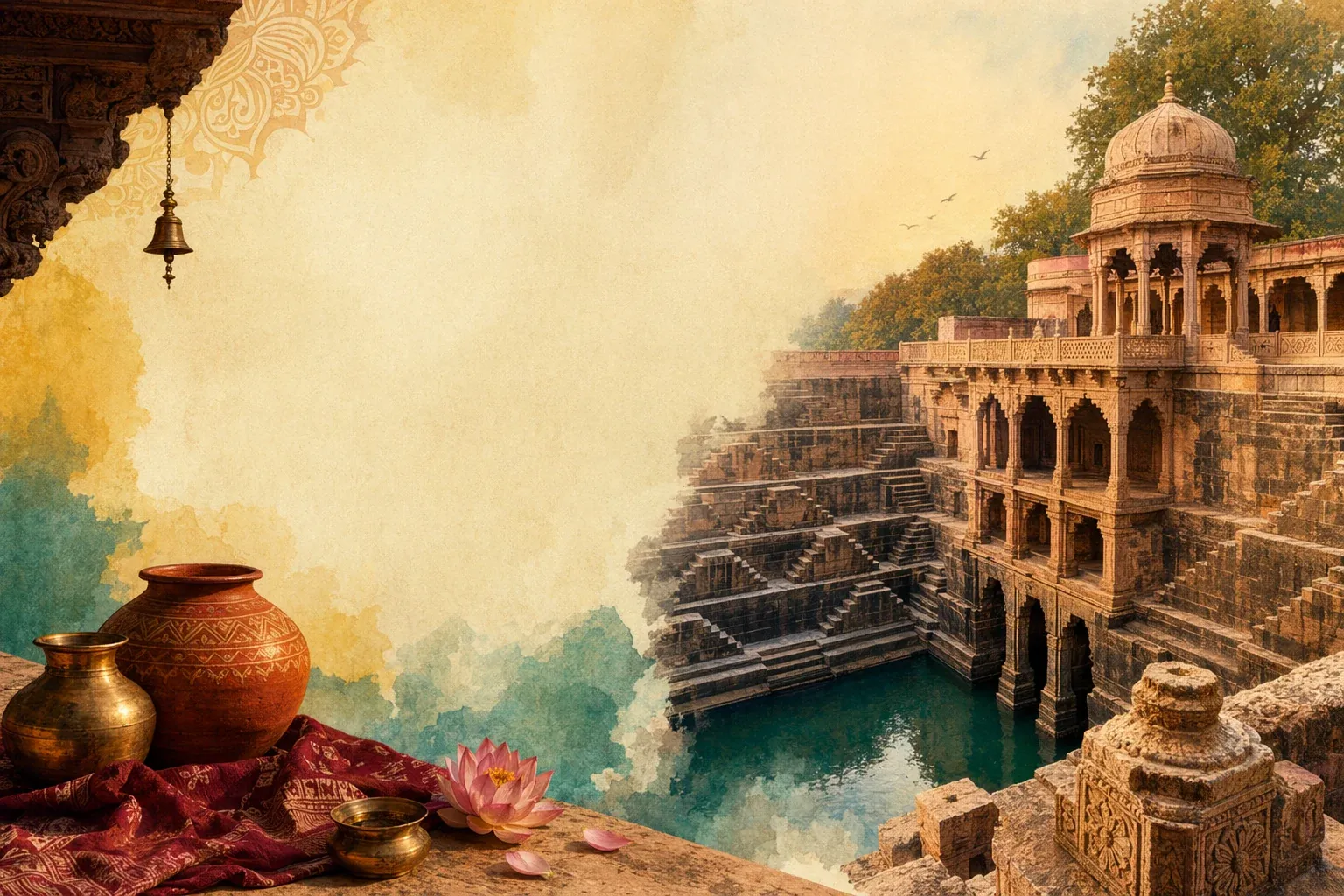
A stepwell is a water structure where people reach water by walking down steps. That is the simplest meaning. Instead of only dropping a bucket into a deep vertical well from above, a stepwell creates a path into the earth, with stairs, landings, corridors, galleries, or chambers that lead toward the water level. In India, these structures became especially important in dry and seasonal regions where water could rise and fall through the year.
For a beginner, imagine a well, a staircase, and a cool underground public space joined together. Some stepwells are plain and practical. Some are grand works of architecture with carved pillars, walls, shrines, and sculptural panels. Many were built to solve a serious water problem, but over time they also became places of rest, community, worship, memory, and local identity.
The basic idea behind a stepwell
India has always had to think carefully about water. Rainfall can be heavy in one season and scarce in another. Rivers, tanks, wells, ponds, canals, johads, temple tanks, and stepwells all belong to this larger story of water wisdom. A stepwell is special because it gives people physical access to water even when the water level changes. If water is high, fewer steps are needed. If water falls lower in summer, people can descend further.
This made stepwells useful in places where ordinary surface water was not reliable all year. The structure could collect, store, and expose groundwater or rain-fed water in a controlled way. The stairs also made cleaning and maintenance easier than a narrow well mouth alone. That is why stepwells should be understood first as infrastructure, not only as tourist monuments.
What they look like from above and below
From above, some stepwells may look like a rectangular opening, a long corridor, or a sunken courtyard. From below, they can feel like a quiet world of stone. A visitor may see flights of stairs descending in straight lines or geometric patterns, side walls that hold the earth, a well shaft at one end, and pillared pavilions or galleries at different levels. In famous examples, the descent itself becomes part of the experience.
Rani ki Vav at Patan in Gujarat is one of the most celebrated examples. Gujarat Tourism describes it as an inverted temple with multiple levels, carved pillars, and many sculptures, especially connected with Vishnu themes. Chand Baori at Abhaneri in Rajasthan is famous for its dramatic geometry and deep, repeating flights of steps. These examples show how a water structure could become architecture, art, and cultural memory at the same time.
Regional names: baoli, baori, vav, and more
Stepwell is the common English word, but India used many local names. In Hindi-speaking and Rajasthani contexts, readers may see baoli, baori, baudi, bawdi, or bawri. In Gujarat, vav or vaav is common. In other regions, related stepped water structures may have different names, such as kalyani, pushkarani, or barav, depending on language, form, and local tradition.
This matters because one English word cannot capture every regional style. A Gujarati vav may not feel exactly the same as a Delhi baoli or a Rajasthani baori. Materials, climate, patronage, religious setting, and local vocabulary shape the structure. Good heritage learning respects these names instead of forcing all of them into one flat label.
Water, shade, and community life
Stepwells were not only about taking water and leaving. Their underground spaces were naturally cooler than the open surface in hot weather. People could rest, meet, talk, pray, or shelter for a while. Travellers, residents, women collecting water, workers, merchants, and pilgrims may have encountered these spaces differently. In some places, the stepwell sat near a temple or settlement; in others, it served a route or community need.
This social side does not cancel the engineering side. It completes it. A structure that handles water also shapes daily routine. It decides where people gather, how far they walk, how they share access, and how a community remembers generosity. When a queen, ruler, merchant, community, or local patron built a stepwell, the act could become public service as well as prestige.
Tradition, history, and careful claims
Stepwells often come with beautiful stories. Some are linked with queens, dynasties, saints, merchants, or local legends. These traditions are valuable, but they should be separated from what inscriptions, archaeology, architecture, and written sources can confirm. For example, Rani ki Vav is traditionally associated with Queen Udayamati of the Chaulukya period, in memory of Bhima I. Chand Baori is often linked with early medieval Rajasthan, but responsible descriptions note uncertainty where direct evidence is limited.
This careful method protects the subject from both exaggeration and dismissal. We can admire a monument without making wild claims. We can say that many stepwells show advanced practical design, artistic skill, and community-minded water management. We do not need to call every one of them the oldest, largest, or most mysterious.
Questions people ask
What is stepwell?
A stepwell is a well, pond, or water reservoir reached by steps. The steps allow people to descend toward the water as the level changes through the seasons.
What are stepwells in India?
In India, stepwells are traditional water structures found especially in western and northern regions. They combine water access, storage, architecture, shade, and community use.
What is a stepwell in English?
In English, stepwell means a stepped well or water structure with stairs leading down to the water. Indian names include baoli, baori, and vav, depending on region and language.
What are stepwells for class 5 or class 6?
A school-level answer can say: stepwells are old Indian water structures with steps going down to water. They helped people collect water, store it, and reach it during dry seasons.
A simple way to remember them
Think of a stepwell as water wisdom carved into the ground. It is practical because it helps people reach water. It is architectural because the stairs, shafts, pillars, and walls must be planned carefully. It is cultural because people used it, named it, protected it, and told stories about it. That combination is why stepwells still matter today.
When we look at a stepwell, we are not only seeing old stones. We are seeing how earlier communities worked with climate, season, labour, beauty, and duty. In a dharmic sense, a good stepwell is a reminder that public welfare can be beautiful. Water is life, and building for water was one way of serving society.