
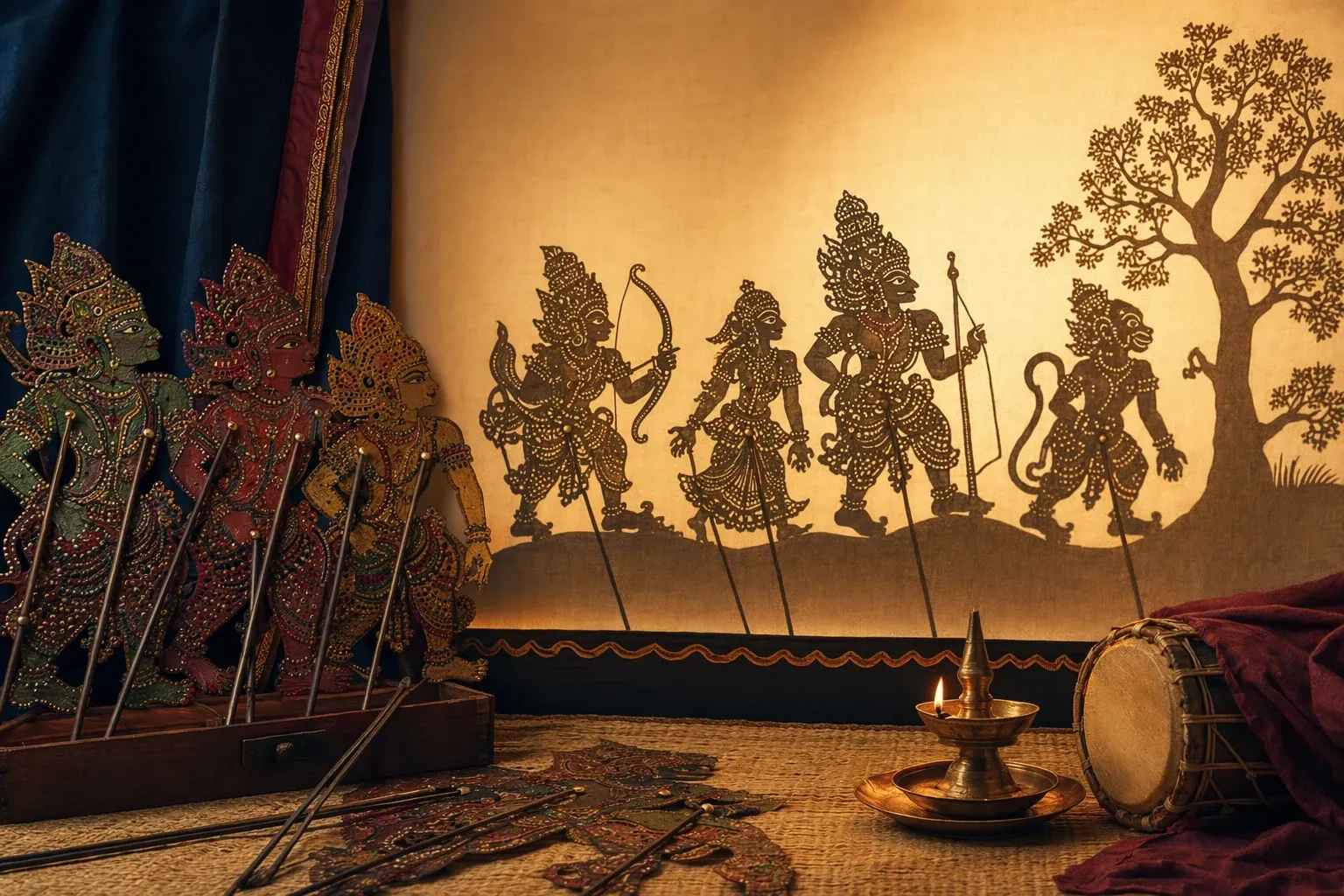
Tholu Bommalata is one of India’s most striking shadow-puppet traditions. The name is usually explained in Telugu as “the dance of leather dolls”: tholu means leather, bomma means doll or figure, and ata means play or dance. The form is closely associated with Andhra Pradesh and Telangana, though related shadow-puppet traditions appear across southern and eastern India under different names. What makes Tholu Bommalata immediately memorable is the scale and brightness of its puppets. Many figures are large, jointed, and painted in vivid colours so that, when light passes through the treated hide, the screen glows with reds, greens, yellows, and blues.
For a beginner, it helps to think of Tholu Bommalata as theatre, music, visual art, and storytelling working at the same time. The audience sees shadows and coloured silhouettes on a white cloth screen. Behind that screen, puppeteers hold the figures close to a light source, move their arms and bodies with rods, speak or sing the roles, and keep the rhythm alive with musicians. A single performance can include devotional storytelling, comedy, moral debate, heroic action, and local humour. It is not simply a children’s amusement. Historically, it was a night-long community performance in village settings, often linked with temple festivals, seasonal gatherings, and public celebrations.
Where Tholu Bommalata belongs
The strongest regional identity of Tholu Bommalata lies in Telugu-speaking areas. Traditional families travelled from village to village with rolled puppets, musical instruments, and a portable screen. They performed episodes from the Ramayana, Mahabharata, and other puranic stories, adapting the narration to the audience and the occasion. In many villages, the performance space was open-air. The screen was tied between poles or set up near a temple courtyard, a street corner, or a common ground. Spectators gathered in front while the performers remained behind the screen, partly hidden and partly audible through song, speech, bells, and drums.
Because performances were mobile, the art carried stories across regions before cinema, television, and phones. The puppeteers were entertainers, ritual specialists, oral historians, painters, singers, and commentators. They preserved familiar plots but also responded to local tastes. A village that loved a comic character might get extra comic exchanges. A festival setting might bring more devotional songs. A mixed-age audience meant the narration could shift between simple explanation for children and layered jokes for adults.
How the puppets are made
Traditional Tholu Bommalata puppets are made from animal hide, commonly goat, deer, or buffalo hide depending on the size and type of figure. The hide is cleaned, stretched, dried, and treated until it becomes thin enough to transmit light. Artists then draw the character, cut the outline, and perforate the surface with patterns. These tiny holes are not random decoration. When the puppet is lit from behind, the perforations sparkle and help define jewellery, crowns, garments, and facial features.
The colours are one of the joys of the form. Older artists used natural pigments, while many contemporary makers use durable modern colours. The hide is painted on one or both sides, and the best puppets retain a jewel-like translucence. A heroic figure such as Rama or Arjuna may have an elegant profile, a tall crown, and graceful limbs. Ravana may have multiple heads, ornate armour, and a more dramatic outline. Hanuman often appears with energetic posture and a tail that helps the audience recognise him quickly. Female characters may be shown with detailed ornaments, hair arrangements, and patterned clothing.
Most important figures are jointed. The shoulders, elbows, wrists, waist, knees, or neck may be connected with small knots or rivets so the puppet can move. Bamboo or cane rods are attached to the body and hands. The puppeteer uses one rod to hold the puppet upright and others to move the arms, turn the figure, make it bow, fight, walk, fly, or gesture. Large puppets may require more than one performer. The craft therefore demands both a painter’s eye and a performer’s understanding of motion.
The screen, light, and stage
The performance depends on a white cloth screen stretched tightly enough to receive a clear image. Traditionally, oil lamps created the shadow and colour. Later, kerosene lamps and electric bulbs became common. The light is placed behind the puppets, with the screen in front. When a puppet is close to the screen, its outline appears sharp; when it is pulled back, the image grows larger and softer. Skilled performers use this distance to suggest entrances, exits, flight, battle, or supernatural presence.
The audience usually watches only the screen, but the real theatre is happening in a narrow space behind it. Puppets are arranged for quick access. Musicians sit nearby. The lead narrator or singer guides the episode. Performers must manage rods, voices, timing, and dialogue while avoiding collisions in the limited backstage area. A battle scene can be surprisingly athletic, with puppets clashing, spinning, and crossing the screen in rapid rhythm.
Stories, music, and humour
The best-known stories come from the Ramayana and Mahabharata. A performance might show Rama’s exile, Sita’s abduction, Hanuman’s leap to Lanka, the war with Ravana, episodes from the Pandavas’ life, or scenes involving Krishna. The characters are familiar to many spectators, so the pleasure lies not only in what happens but in how it is told: the singer’s voice, the timing of a joke, the beauty of a puppet’s movement, and the emotional weight of a devotional scene.
Music gives structure to the performance. Harmonium, cymbals, drums, and local percussion may accompany the singers, though exact instrumentation varies by troupe and period. Songs announce characters, deepen emotion, and mark transitions. Speech and song often move together. A serious scene may shift into a comic exchange before returning to the main story. Clown figures and attendants are important because they connect epic events to everyday village life. Through them, puppeteers could comment on prices, quarrels, marriage customs, officials, weather, or social habits without breaking the performance’s energy.
Why the leather figures are so large
Many Tholu Bommalata puppets are larger than the small hand puppets people may imagine when they hear the word “puppet.” Some can approach human scale, especially major characters. The size helps the figures fill an outdoor screen and remain visible to a large audience. It also gives the movement dignity. When Rama raises a bow or Ravana turns with a towering crown, the screen can feel monumental. The scale is one reason the tradition has such visual power.
At the same time, size creates practical challenges. Large leather figures are heavy. They require strong rods, careful storage, and trained hands. Travelling artists had to carry an entire repertoire: gods, kings, demons, sages, animals, chariots, trees, palaces, and comic characters. A troupe’s collection represented years of work and family inheritance. Damaged puppets had to be repaired; new ones had to match the style and needs of the stage.
What a first-time viewer should notice
If you are watching Tholu Bommalata for the first time, notice the relationship between outline and ornament. The screen shows both silhouette and colour. Look for perforated jewellery, patterned skirts, pointed crowns, curved bows, and the way a hand gesture changes a character’s mood. Listen for how the singer introduces a scene and how percussion follows movement. Watch the comic characters carefully; they often explain the action and keep the audience emotionally close to the story.
Also notice that the screen is not a barrier but a creative surface. The puppeteer knows exactly how much to reveal. A figure may appear slowly from one side, suggesting suspense. A demon may suddenly expand by moving closer to the light. Two warriors may seem to strike each other with speed even though the performers are managing rods from behind cloth. This combination of visible image and hidden labour is central to the magic of shadow puppetry.
The tradition today
Tholu Bommalata has faced serious pressure from cinema, television, urban migration, and shrinking patronage for long village performances. Many hereditary artists have had to find new ways to continue: shorter stage shows, school demonstrations, museum workshops, cultural festivals, craft exhibitions, and decorative leather-lamp products inspired by puppet-making techniques. Some performers still present epic episodes, while others create educational shows on health, environment, literacy, or social themes.
This change brings both opportunity and risk. Shorter shows can introduce new audiences to the art, but the older all-night format, deep repertoire, and improvisational humour are harder to sustain. Buying a painted leather wall hanging is not the same as supporting living performance. The art survives most fully when puppet makers, singers, musicians, and storytellers all have a place to work.
Direct FAQs
Is Tholu Bommalata the same as all Indian shadow puppetry?
No. It is a Telugu shadow-puppet tradition of Andhra Pradesh and Telangana. India has other shadow forms too, such as Togalu Gombeyata in Karnataka, Tholpavakoothu in Kerala, Ravana Chhaya in Odisha, and Chamadyache Bahulya in Maharashtra. They share the basic idea of figures casting shadows on a screen, but their puppet materials, size, music, stories, and staging differ.
Are the puppets opaque black shadows or coloured images?
Tholu Bommalata puppets are usually translucent leather figures painted in strong colours. Under good lighting, the audience sees coloured shadows and glowing ornament rather than plain black silhouettes.
What stories are performed?
Episodes from the Ramayana and Mahabharata are central, especially scenes involving Rama, Sita, Hanuman, Ravana, the Pandavas, Krishna, and heroic battles. Performers may also include local humour, devotional songs, and contemporary messages.
Can beginners understand a performance without knowing Telugu?
Yes, at least visually. Knowing Telugu or the story helps, but the movement, music, character shapes, and dramatic action communicate a lot. A short introduction before the show makes the experience much easier for new viewers.
Why is the tradition important?
It preserves leather craft, oral storytelling, regional music, ritual memory, and community theatre in one form. It also shows how Indian performance traditions can combine sacred narrative with humour, spectacle, and local social life.