
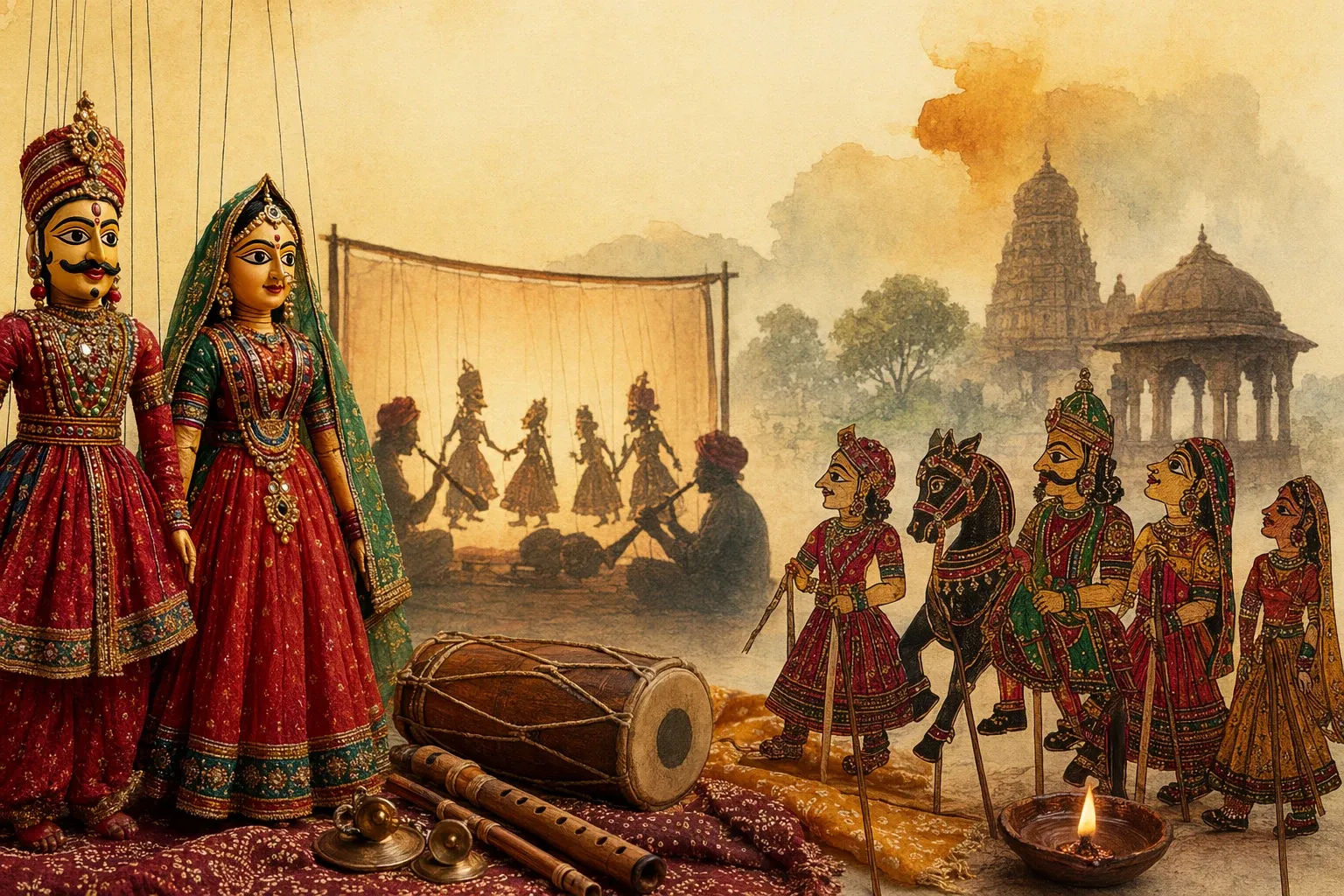
The history of Indian puppetry is not a single straight line. It is a web of travelling performers, temple stories, courtly entertainment, village festivals, family traditions, religious narration, craft skills and changing audiences. Puppets appear in India as toys, ritual objects, teaching tools, theatre figures and decorative craft, but the performance tradition is especially important because it joins story, music and movement in a compact form. A puppet may be small, but the world it carries can be vast.
Indian puppetry is often described as ancient, and that is broadly true in the sense that puppets and animated figures have long been part of South Asian imagination. References to dolls, stringed figures and performance metaphors appear across older literature and cultural memory. The Sanskrit word “sutrad hara” is often explained as “holder of strings” and later became a term for the stage manager or narrator in classical theatre. Even when exact dates are difficult, the metaphor itself tells us something important: Indian storytelling imagined control, narration and theatrical illusion through the idea of strings.
Before modern stages: the travelling storyteller
For most of history, Indian puppetry lived outside fixed theatre buildings. Performers travelled to villages, courts, markets, fairs, temple precincts and seasonal gatherings. They carried a portable theatre: puppets, costumes, drums, cymbals, lamps, a screen if needed, and memory. This portability made puppetry ideal for a subcontinent where stories had to move across distance and language.
A puppet troupe could arrive in a village and create an event without permanent infrastructure. In the evening, a cloth might be stretched, lamps lit, drums tuned and characters introduced. People who had heard the Ramayana many times could still gather because the pleasure was not only in the plot. It was in the local jokes, the singer’s voice, the puppets’ movements, the familiar hero’s entrance, the demon’s exaggerated face and the way an old episode spoke to the village’s present concerns.
Epics, Puranas and local memory
The Ramayana and Mahabharata became major reservoirs for puppet theatre because they offered long, flexible story cycles. A troupe did not need to perform the entire epic every time. It could choose one episode: Sita’s swayamvara, Rama’s exile, Hanuman in Lanka, the killing of Ravana, Draupadi’s humiliation, Arjuna’s doubt, Krishna’s advice, Abhimanyu’s courage or Bhima’s strength. These episodes already lived in song, recitation, temple art and folk memory, so the puppet show entered a larger storytelling ecosystem.
Puranic and devotional stories added more material. Krishna’s childhood, Radha and Krishna episodes, Shiva legends, goddess stories and local saints could all be adapted. In Odisha, Krishna themes appear in several puppet traditions. In Kerala’s Tholpavakoothu, the Ramayana has been performed in ritual settings linked to Bhagavati temples. In Rajasthan, Kathputli traditions often preserved heroic and courtly memory along with folk entertainment. This ability to absorb both pan-Indian epics and local stories is one reason puppetry survived for so long.
Regional traditions take shape
Over time, puppetry became deeply regional. The same broad technique could produce very different forms depending on local materials, musical systems, costume styles and patronage. Rajasthan’s Kathputli developed as a bright, mobile string-puppet theatre associated with the Bhat community. Its wooden figures, long skirts, swift turns and courtly atmosphere fit the desert region’s storytelling culture and patronage histories.
In South India, shadow puppetry developed into several powerful traditions. Andhra Pradesh and Telangana’s Tholu Bommalata used large, coloured leather figures whose perforations and paint came alive against a lit screen. Karnataka’s Togalu Gombeyatta used leather puppets in sizes and designs shaped by local aesthetics. Kerala’s Tholpavakoothu linked shadow performance to temple ritual and Ramayana recitation. Odisha’s Ravanachhaya created a distinctive shadow style with strong silhouettes and Ramayana themes.
Rod puppetry also developed regional identities. West Bengal’s Putul Nach turned large puppets into dancing dramatic figures. Odisha’s Kathi Kundhei Nacha used rods in its own performance environment. Bihar’s Yampuri became known for wooden figures that require skilled manipulation despite limited joints. Glove puppetry produced intimate forms such as Kerala’s Pavakathakali, which miniaturised Kathakali’s visual language, and Odisha’s Sakhi Kundhei, linked with Krishna-Radha narratives.
Patronage: courts, temples, villages and families
Puppetry survived because different kinds of patrons supported it at different times. Courts could value entertainment, praise, genealogy and spectacle. Temples could support ritual storytelling and devotional performance. Villages could host troupes during festivals, fairs, harvest periods or special occasions. Families supported the tradition by training children, repairing puppets, preserving songs and maintaining performance rights.
Hereditary transmission mattered enormously. A puppet artist did not simply inherit objects; the artist inherited timing, dialect, repertoire, voice technique, comic patterns, craft repair, musical cues and audience knowledge. A young performer learned when to pause for laughter, how to make a demon frightening but enjoyable, how to handle a lamp, how to untangle strings, how to improvise if a puppet broke, and how to shorten or expand a story depending on the crowd.
What changed under colonial and modern conditions
Colonial rule, new forms of administration, changing court patronage, urban entertainment and modern schooling altered the cultural economy around puppetry. Some royal and landlord support declined. Later, cinema, radio, television and digital media offered cheaper or more glamorous entertainment. Migration pulled younger generations away from hereditary performance. In many places, puppeteers had to adapt by performing at government programmes, cultural festivals, schools, tourist venues and museums.
This change was not only a story of decline. Puppetry also entered new spaces. Educators used puppets for health messages, literacy, environmental awareness and classroom teaching. Cultural organisations documented forms, held workshops and created festivals. Modern theatre practitioners experimented with puppets in contemporary plays. Some artists created new scripts about social issues while keeping traditional movement and music. Others made decorative puppets for sale, which helped livelihoods but sometimes separated the object from the performance tradition.
Why shadow puppetry has a special historical place
Shadow puppetry is especially important in discussions of history because it connects India to wider Asian performance worlds. Leather shadow traditions are found across South and Southeast Asia, and scholars often compare Indian forms with traditions such as Indonesian wayang. It is difficult to reduce these connections to a simple one-way origin story, but the similarities show how stories, religions, trade routes, artists and visual techniques travelled across regions.
Within India, shadow puppetry also shows how technology and devotion can meet. A lamp, a screen and a leather figure create an image that is both present and absent. The audience sees Rama or Ravana, but also knows it is a shadow. This makes the form especially suitable for epic and sacred material, where imagination matters as much as realism.
The modern revival question
Today, the question is not whether Indian puppetry has history. The question is how that history can remain alive. Museum displays, documentation and academic writing are useful, but puppetry is a performing art. It needs artists, rehearsal, audiences, payment, apprentices and occasions to perform. A puppet kept in a glass case can teach us about craft, but it cannot reproduce the full experience of drums, jokes, shadows, voices and audience response.
Revival also needs respect for artists as knowledge holders. Traditional puppeteers are not merely carriers of “folk culture”; they are directors, actors, singers, designers, carpenters, leather workers, painters, musicians, teachers and entrepreneurs. Their history includes artistic intelligence as well as hardship. Supporting Indian puppetry means supporting performances, fair fees, documentation in local languages, school exposure, apprenticeships and spaces where old stories and new themes can meet.
How to read the history as a beginner
A beginner should avoid two extremes. One extreme is to treat puppetry as a cute craft with no depth. The other is to treat it as a frozen ancient relic. Indian puppetry is better understood as a living storytelling system. It has old roots, but it has always changed with audience, patronage, materials and purpose. The same art could entertain a king, teach a child, serve a temple ritual, carry a public-health message or preserve a regional version of an epic.
When you look at an Indian puppet, ask three historical questions. Where is it from? How is it moved? What story world does it belong to? Those questions will lead you from the object to the performer, from the performer to the community, and from the community to India’s larger storytelling history.
FAQs
How old is Indian puppetry?
Indian puppetry has very old roots, but exact dates vary by form and evidence. It is safest to say that puppet-like figures and string metaphors are ancient, while specific regional traditions developed over long periods through local communities.
Was Indian puppetry mainly religious?
Religion was very important, especially through the Ramayana, Mahabharata, Puranic stories and temple-linked forms. But puppetry also included humour, courtly entertainment, local legends, social messages and everyday satire.
Who preserved Indian puppetry?
Hereditary performer families and communities preserved much of it by passing down puppets, songs, scripts, craft skills and performance timing. Cultural institutions, schools and modern theatre groups now also help document and present the forms.
Why did some puppet traditions decline?
Changing patronage, cinema, television, migration, reduced village performance circuits and uncertain income all affected puppeteers. Some traditions continue, but often with fewer regular performance opportunities.
Is Indian puppetry still changing?
Yes. Artists use puppets in education, festivals, contemporary theatre and social-awareness programmes. The challenge is to innovate without losing the regional knowledge and performance depth of traditional forms.