
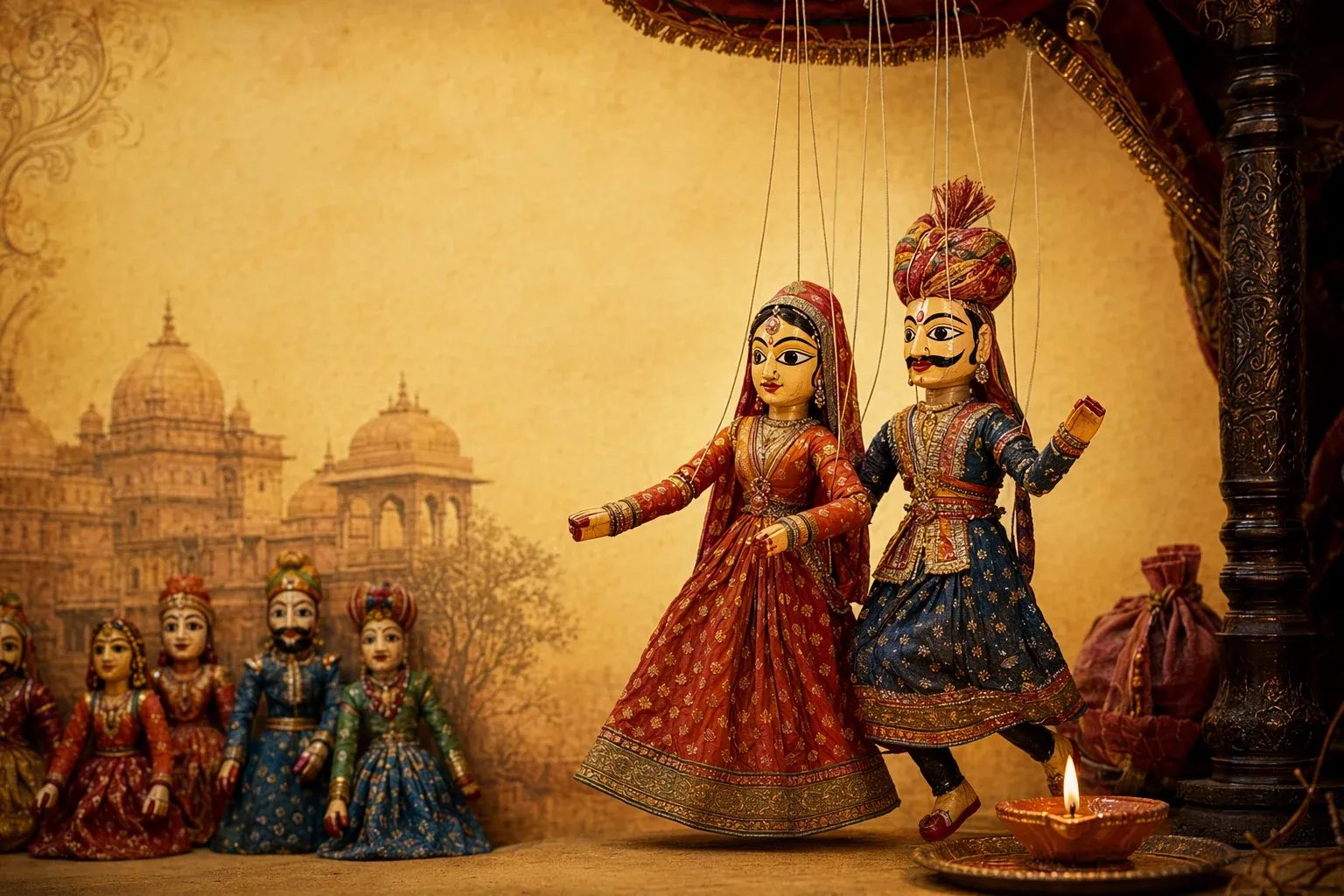
Indian string puppets are often called marionettes in English, but the word “marionette” does not fully capture their regional variety. A string puppet is a figure moved from above by threads, cords, or wires attached to the head, shoulders, hands, waist, or knees. In India, these figures are shaped by local woodwork, cloth, painting styles, music, storytelling habits, and performance spaces. The quick, swirling Kathputli of Rajasthan does not look or move like the large Bommalattam puppets of Tamil Nadu. Kundhei from Odisha, Gombeyatta from Karnataka, and other regional forms have their own accents too.
For beginners, the easiest way to understand Indian string puppetry is to watch three things: the control system, the body design, and the performance style. The control system tells you how the puppet moves. The body design shows what the puppet is built to do. The performance style reveals the world it belongs to: royal courts, temple festivals, village squares, itinerant entertainment, devotional storytelling, or modern cultural stages. These elements make Indian string puppets more than handmade toys. They are compact theatres carried in wood, cloth, paint, voice, and rhythm.
What makes a string puppet different
In glove puppetry, the hand goes inside the figure. In rod puppetry, rods support and move the body. In shadow puppetry, the audience watches images cast on a screen. String puppetry works through suspension. The puppet hangs from strings, and the performer controls it from above, often behind a small stage frame. This allows the figure to dance, bow, turn, sway, or walk without the puppeteer being fully visible. The body must be balanced carefully. If the head is too heavy, the figure droops. If the strings are wrongly placed, the arms twist or the feet drag. A good puppet seems lively because its maker and performer have solved these hidden engineering problems.
Indian string puppets are usually made of light wood, cloth, cotton stuffing, metal ornaments, and painted details. The head and torso may be carved; the lower body may be a flowing costume rather than fully carved legs. This is especially true in Kathputli, where the skirt’s movement is part of the charm. Some traditions use more complex joints and heavier bodies. The number of strings varies. A simple puppet may have only a few strings; a more elaborate one may have strings for the head, hands, shoulders, back, and knees.
Kathputli of Rajasthan
Kathputli is the best-known Indian string-puppet tradition internationally. The word comes from kath, meaning wood, and putli, meaning doll. It is associated with Rajasthan, especially communities of hereditary performers who travelled with portable theatres. Kathputli figures are usually carved from wood, painted with bold facial features, dressed in bright Rajasthani textiles, and decorated with turbans, veils, jewellery, and mirror-work effects. Many female puppets do not have separate legs; their long skirts create the illusion of spinning dance.
The movement of Kathputli is fast, rhythmic, and theatrical. A dancer puppet can whirl repeatedly, its skirt opening like a small burst of colour. A courtier can nod sharply. A warrior can gesture with a sword. Performers often use a high-pitched reed whistle or vocal device called a boli to create a distinctive puppet voice, while another performer interprets or answers in spoken language. Drums and songs help maintain tempo. The show may include kings, queens, snake charmers, horse riders, acrobats, dancers, and comic characters.
Historically, Kathputli performances carried stories of Rajput heroes, local rulers, romance, bravery, and social satire. The portable stage could be set up in a village, a market, a courtyard, or a patron’s home. The puppeteer’s skill lay not only in manipulation but in timing. A small wooden figure has to appear proud, foolish, graceful, drunk, brave, or flirtatious through very limited movement. Kathputli performers achieve this with sharp rhythms, sudden turns, and playful dialogue.
Bommalattam of Tamil Nadu
Bommalattam, also written as Bommalatta or Bommalattam, is a Tamil puppet tradition whose name means “doll dance” or “puppet play.” It is especially notable because some Bommalattam puppets combine string and rod techniques. The figures can be large and heavy compared with Kathputli. They may have carved wooden heads, arms, and legs, with bright costumes and painted faces suited to mythological or folk-theatre characters. The puppeteer may use strings attached to a control and rods connected to the hands, giving the puppet a weighty, dramatic movement.
Bommalattam has strong links with temple festivals and devotional storytelling in Tamil Nadu. Episodes from the Ramayana, Mahabharata, Krishna stories, local legends, and moral tales may be performed. The stage can feel closer to live folk drama than to a quick variety show. The characters enter, speak, sing, argue, fight, bless, or lament. Because the puppets can be large, their gestures have a grand quality. A divine figure may raise a hand in blessing; a demon may stamp or swing a weapon; a comic attendant may exaggerate everyday speech.
Music and narration are central. Traditional instruments and songs vary by troupe, but the performance often depends on a narrator-singer who carries the story while puppeteers animate the figures. The combination of rods and strings allows more controlled arm gestures than many simple marionettes. This is useful in Indian storytelling, where hand positions, bows, weapons, and expressive exchanges matter. Bommalattam therefore shows that “string puppet” is not a single technical formula. Indian traditions often mix methods when the stage demands it.
Kundhei of Odisha
Odisha’s string-puppet tradition is commonly known as Kundhei or Sakhi Kundhei. The puppets are usually small, brightly dressed, and controlled by strings. They may perform episodes influenced by local devotional culture, especially stories connected with Krishna and Radha, alongside social and comic scenes. Odisha also has the famous shadow tradition Ravana Chhaya, so Kundhei sits within a wider regional puppetry landscape rather than standing alone.
Kundhei figures often have a gentle, lyrical quality. Their costumes and songs reflect local aesthetics, and performances may include dance-like movement. Because the puppets are smaller than some southern marionettes, the focus is often on intimate storytelling and musical charm rather than monumental spectacle. A beginner can compare Kundhei with Kathputli and notice how two string traditions can use similar suspension principles but create very different moods.
Gombeyatta of Karnataka
Karnataka has string-puppet forms often referred to as Gombeyatta or Gombe Ata, meaning puppet play. These traditions may show the influence of Yakshagana, the vibrant theatre form known for elaborate costumes, music, and mythological drama. Puppets may wear ornate headgear and dramatic clothing inspired by live performers. Stories from the epics are common, and the show may combine narration, song, percussion, and dialogue.
The regional theatre connection matters. A puppet is not only a small figure; it carries the style of a larger performance culture. When a Gombeyatta puppet wears a crown or moves in a heroic stance, it evokes Karnataka’s stage traditions. The strings allow the figure to dance and gesture, while the music sets a strong dramatic pace. This makes the puppet feel like a miniature actor from a familiar theatrical world.
Common features across Indian string puppets
Despite regional differences, several features repeat across Indian string-puppet traditions. First, the figures are usually stylised rather than realistic. Large painted eyes, sharp noses, strong moustaches, crowns, turbans, and bright costumes help spectators identify characters quickly. Second, music is rarely optional. Drums, cymbals, songs, whistles, or spoken rhythms guide the movement and keep attention focused. Third, performances often blend serious and comic material. A heroic story may include clowning; a devotional episode may pause for a joke; a courtly scene may become social satire.
Fourth, puppetry is usually a family or community art. Skills pass through practice: carving, painting, stitching, singing, instrument playing, stage setting, and audience handling. Fifth, portability matters. Many puppeteers historically moved from place to place, so the stage, puppets, and instruments had to be carried, assembled, repaired, and adapted to different audiences. This mobility shaped the compact design of the puppets and the flexible structure of performances.
How to watch a string-puppet performance
A first-time viewer should look beyond the strings. Notice how the performer creates weight. Does the puppet seem to step, glide, jump, or spin? Watch how costumes hide or reveal the body. In Kathputli, the skirt may replace visible legs and turn spinning into character. In Bommalattam, heavier limbs and rods may create stronger gestures. Listen for the relationship between music and movement: a drumbeat may trigger a turn, a song may slow the scene, and a whistle may become the puppet’s voice.
Also watch how scale changes the mood. Small puppets can be quick and comic. Large puppets can feel ceremonial. A simple control system can produce dazzling speed, while a complex system can support expressive detail. None is automatically better. Each tradition developed for its own audience, stories, materials, and patrons.
Why these traditions still matter
Indian string puppetry carries regional history in a form that is easy to underestimate. A Kathputli dancer preserves Rajasthani costume and performance wit. A Bommalattam hero preserves Tamil devotional theatre and skilled wood-and-cloth construction. A Kundhei figure preserves local songs and miniature movement. A Gombeyatta character preserves the memory of larger theatrical forms. Together, they show how storytelling can travel without printed books or digital screens.
Today, many puppeteers perform at festivals, schools, museums, tourist venues, and cultural events. Some create shorter shows for contemporary audiences. Others teach puppet-making workshops or use puppetry for education. The challenge is to keep performance knowledge alive, not only the decorative object. A puppet hanging on a wall is beautiful, but a puppet moving in rhythm, speaking in a local voice, and meeting an audience is the heart of the tradition.
Direct FAQs
What is the main difference between Kathputli and Bommalattam?
Kathputli from Rajasthan is usually lighter, faster, and known for swirling movement, bright costumes, and lively variety scenes. Bommalattam from Tamil Nadu often uses larger figures and may combine strings with rods, giving it a more dramatic, theatre-like style suited to mythological storytelling.
Are Indian string puppets only for children?
No. Traditional performances were made for mixed village and courtly audiences. They included heroism, devotion, satire, romance, comedy, and moral storytelling. Children can enjoy them, but the art is not limited to children.
What materials are used?
Common materials include light wood, cloth, cotton stuffing, paint, metal ornaments, thread, cords, bamboo or wooden controls, and region-specific textiles. Bommalattam may use heavier carved parts and rods, while Kathputli often relies on carved heads and flowing costumes.
Why do some puppets have no visible legs?
In forms such as Kathputli, a long skirt can create the illusion of dance and spinning without carved legs. This makes the puppet lighter and emphasizes graceful circular movement.
Which Indian regions are famous for string puppetry?
Rajasthan is famous for Kathputli, Tamil Nadu for Bommalattam, Odisha for Kundhei, and Karnataka for Gombeyatta or related marionette forms. Other regions also have local puppet practices and mixed techniques.