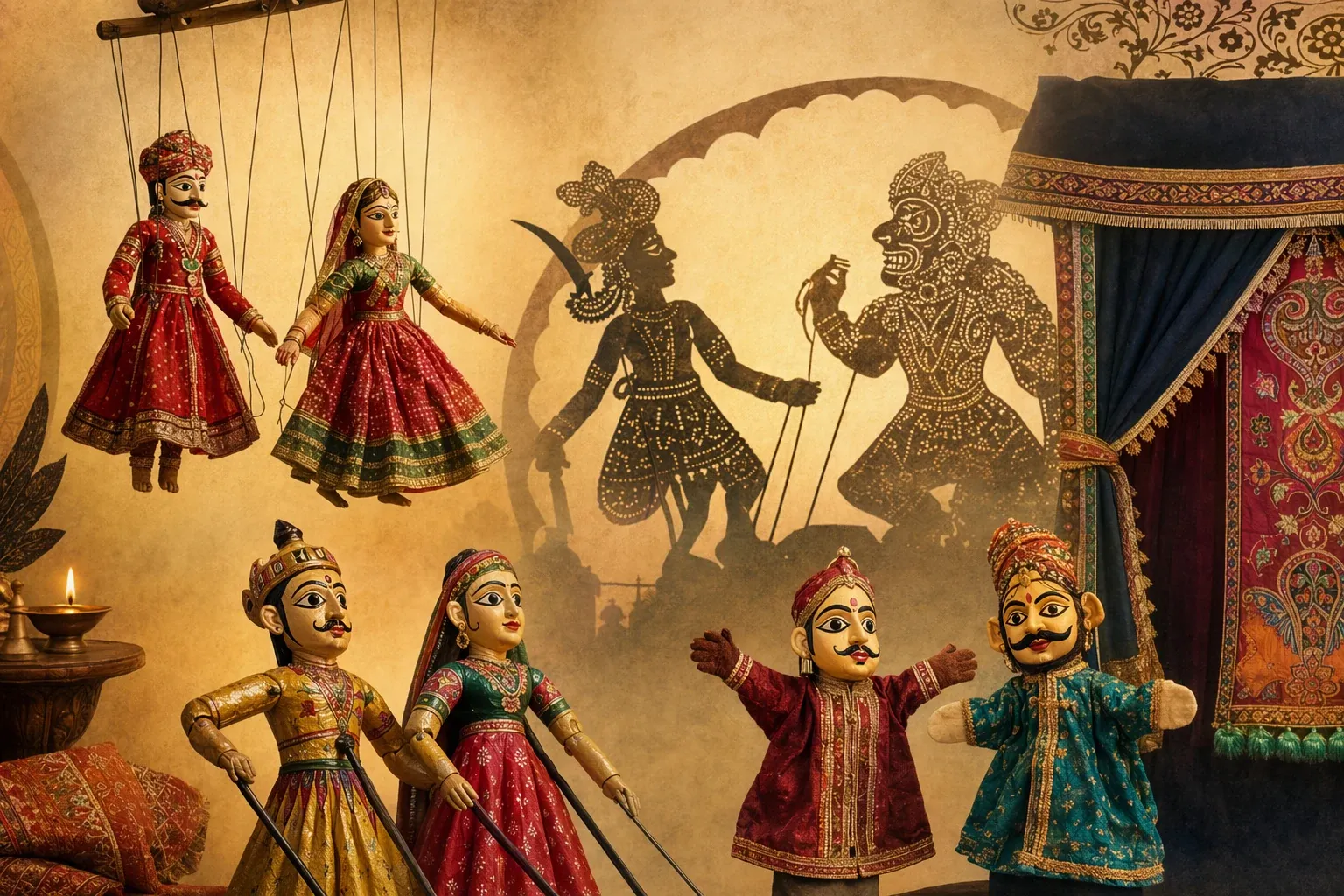
Indian puppetry is usually explained through four main types: string puppets, shadow puppets, rod puppets and glove puppets. This classification is useful because it tells us how the puppet is moved. But the real beauty appears when we look at regional forms. A Rajasthani Kathputli and an Odia Kundhei are both string puppets, yet they do not look, sound or move in the same way. Andhra’s Tholu Bommalata and Kerala’s Tholpavakoothu are both shadow traditions, yet one is known for large coloured leather figures while the other has a deeply temple-linked Ramayana performance culture.
So the best way to learn the types of Indian puppetry is to hold two ideas together. First, identify the technique: string, shadow, rod or glove. Second, connect that technique to a place, community, language, music and story tradition. That prevents the art from becoming a dry list and helps you recognise what makes each form distinctive.
String puppetry: figures moved from above
String puppets, often called marionettes in English, are three-dimensional figures controlled by strings attached to the head, shoulders, arms, hands or other parts of the body. The puppeteer usually stands above or behind a small stage and controls movement by pulling, loosening and balancing the strings. Good string puppetry looks effortless, but it depends on exact rhythm. Too much pull makes the puppet jerk; too little makes it collapse.
Kathputli of Rajasthan is the form many Indians first think of when they hear “puppet”. The word is commonly understood from “kath” meaning wood and “putli” meaning doll. The figures have carved wooden heads, painted features, bright costumes and long skirts that often hide the absence of legs. The traditional performers are associated with the Bhat community. Kathputli shows may include kings, queens, warriors, snake charmers, dancers and comic characters. The quick spins and dramatic entrances suit stories of Rajasthani courts, heroic legends and folk entertainment.
Kundhei of Odisha is another string tradition, but it has a different emotional texture. The puppets are usually lighter, dressed in regional styles, and accompanied by Odia songs and narration. Krishna stories and episodes from the epics are common. Odisha also has related forms using rods and glove techniques, so the word Kundhei can appear in more than one local context.
Gombeyatta of Karnataka connects with the visual world of Yakshagana, the region’s dance-drama tradition. The puppets may wear bold headgear and costumes that echo stage performers. This makes them especially useful for epic scenes, because the audience can recognise a heroic or demonic character through costume design before a line is spoken.
Bommalattam of Tamil Nadu is often described as a combination of string and rod puppetry. The puppets can be large and heavy, and the performer may use both overhead strings and rods for control. This hybrid technique allows sweeping movements and clearer gestures, especially in mythological scenes. Bommalattam shows traditionally draw from the Ramayana, Mahabharata, Puranas and local devotional stories.
Shadow puppetry: stories made with light
Shadow puppetry works through a screen. The puppeteer stands behind a white cloth or screen, places a flat puppet between the screen and a light source, and manipulates the figure with rods. The audience sees the puppet’s shadow, colour, outline and movement. In India, many shadow puppets are made from treated leather, cut with decorative perforations and painted. When light passes through the leather, jewellery, crowns and clothing patterns can glow beautifully.
Tholu Bommalata, found in Andhra Pradesh and Telangana, means the play or dance of leather puppets in Telugu. These puppets can be large, colourful and jointed, with movable arms and sometimes detailed body parts. Ramayana and Mahabharata episodes are central, but performers also include humour and local references. A performance combines singing, dialogue, instruments and puppet movement, often creating the feeling of a full theatre hidden behind a screen.
Togalu Gombeyatta is Karnataka’s leather shadow puppet tradition. Puppet size can vary by the importance of the character: gods and kings may be larger, while attendants or comic figures may be smaller. The visual style draws from local art, temple imagery and performance conventions. Like many South Indian shadow traditions, it uses epic material but adapts it to local language, rhythm and audience taste.
Tholpavakoothu of Kerala is strongly associated with the Ramayana and temple settings, especially in parts of Kerala where performances were linked to Bhagavati temples. The word includes “thol” for leather, “pava” for doll and “koothu” for play or performance. The emphasis is not only on entertainment but also on ritual continuity, recitation and devotion.
Ravanachhaya of Odisha is a shadow form named after Ravana’s shadow. It is known for its distinctive silhouette style. Unlike some coloured leather traditions, its visual power often comes from strong dark shapes and careful movement. The Ramayana, especially regional retellings, is important to this form.
Rod puppetry: bold gestures and large figures
Rod puppets are controlled by rods, usually from below or behind. A central rod may support the body or head, while smaller rods control the hands. Because rods can carry more weight than strings, rod puppets are often larger and sturdier. Their gestures can be direct and dramatic, which makes them effective for public performances.
Putul Nach of West Bengal literally means puppet dance. Some Bengal rod puppets are large enough to resemble miniature actors. The puppeteer may stand behind a screen or hold the puppet from below while manipulating rods attached to the hands. The figures wear colourful costumes and perform stories from mythology, local tales and social themes. The “dance” aspect is important: rhythm, swaying and gesture are as meaningful as dialogue.
Kathi Kundhei Nacha of Odisha uses rod puppets and reflects Odisha’s broader puppet culture. “Kathi” refers to sticks or rods, and “kundhei” means doll or puppet. These performances can feature mythological stories, devotional themes and regional music. Because Odisha also has string and glove puppet forms, Kathi Kundhei Nacha is a good reminder that one state may contain several puppet technologies.
Yampuri of Bihar is often noted because its wooden puppets traditionally have fewer joints than many other forms. That makes manipulation demanding: the puppeteer must create life through whole-body movement rather than fine articulation. The result can feel raw, forceful and direct.
Glove puppetry: a puppet on the hand
Glove puppets are worn over the puppeteer’s hand. Usually the index finger controls the head while the thumb and another finger control the arms. Because the hand is inside the puppet, the movement can be quick, intimate and expressive. Glove puppetry is especially effective for dialogue, comic exchange and close-up performance.
Pavakathakali of Kerala is one of India’s most visually memorable glove puppet forms. It adapts the look of Kathakali dance-drama into puppet scale: elaborate headgear, painted faces, ornamental costume and strong character types. The puppet is small compared with a human Kathakali actor, but the visual language is related, so a viewer familiar with Kathakali can recognise heroic, demonic or noble identities.
Sakhi Kundhei of Odisha is a glove puppet tradition often linked with Krishna and Radha stories. Its scale is smaller than large rod or shadow forms, but the intimacy helps in romantic, devotional and conversational scenes.
Benir Putul or related Bengal glove puppet traditions show how hand puppets can become vehicles for humour and social observation. With only a few figures, a performer can create quarrels, jokes, domestic scenes and moral messages.
How the types differ in experience
String puppets often feel airy, rhythmic and dance-like because they hang and swing. Shadow puppets feel magical because the audience sees an illuminated world rather than the performer. Rod puppets feel strong and public because they can be larger and more forceful. Glove puppets feel immediate because the performer’s hand gives them quick reactions. None is superior. Each type solves a different theatrical problem.
If the story needs a glowing battle between Rama and Ravana, shadow puppetry can create scale. If the story needs a dancing court entertainer, string puppetry can bring sparkle. If the story needs a large village heroine or a social drama, rod puppetry can project authority. If the story needs a witty exchange between two characters, glove puppetry can move quickly from line to line.
FAQs
What are the four main types of Indian puppetry?
The four main types are string, shadow, rod and glove puppetry. They describe how the puppet is moved, not the full cultural identity of the form.
Which Indian puppetry type uses leather?
Many shadow puppet traditions use treated leather, including Tholu Bommalata, Togalu Gombeyatta and Tholpavakoothu. The leather is cut, painted and held before a lighted screen.
Is Kathputli a string puppet?
Yes. Kathputli is a Rajasthani string puppet tradition, usually associated with wooden figures, colourful costumes and hereditary performer communities.
Which form is connected with Kathakali?
Pavakathakali of Kerala is a glove puppet form influenced by Kathakali’s costume, makeup and character types.
Can one puppet form use more than one technique?
Yes. Tamil Nadu’s Bommalattam is commonly described as combining string and rod techniques, showing that regional practice can be more flexible than textbook categories.