
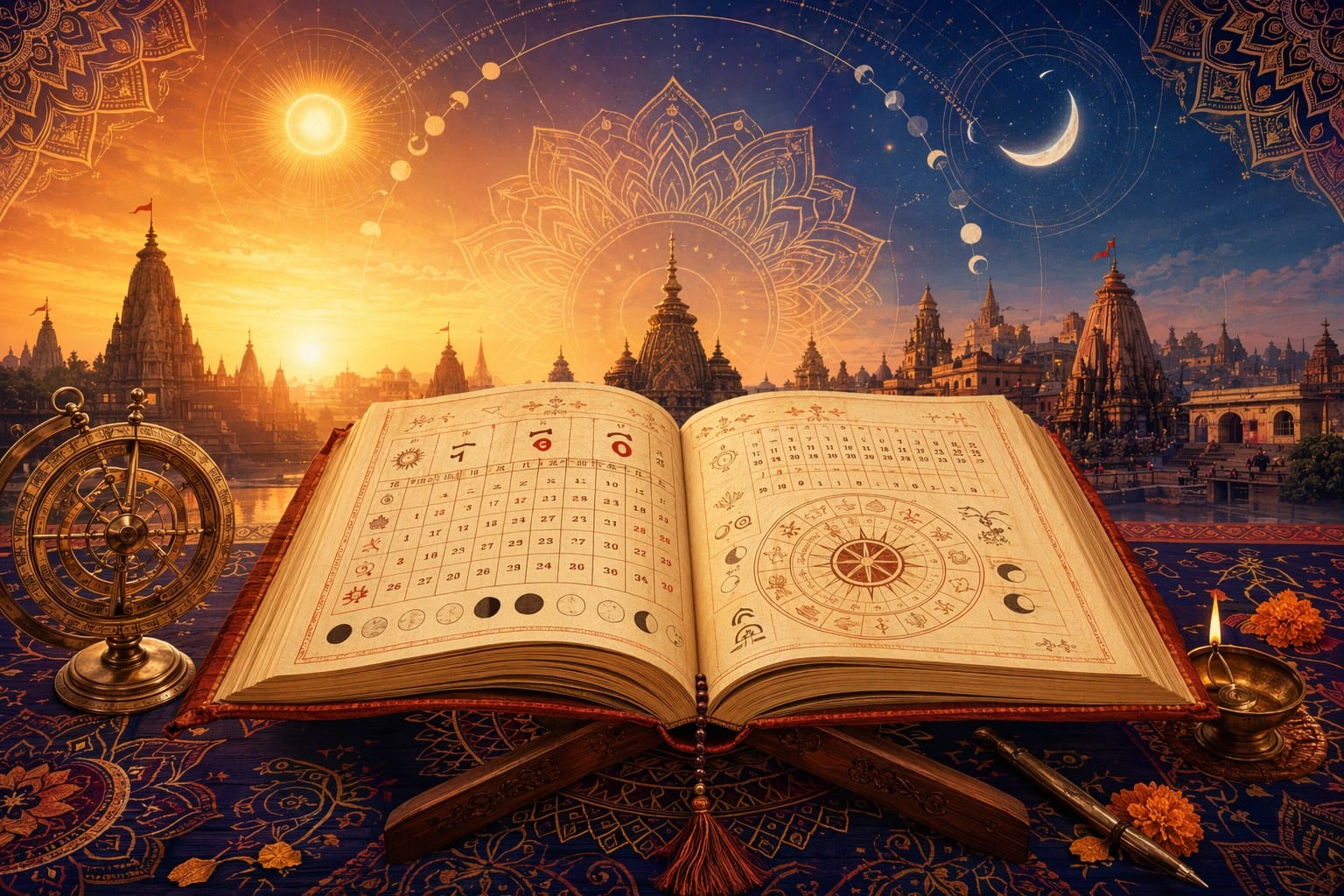
If you have ever seen a Hindu calendar and wondered why the year number looks “ahead” of the normal calendar year, you have probably met Vikram Samvat.
In simple words, Vikram Samvat is a traditional Indian calendar era used in Hindu cultural and religious life. It is especially connected with panchang, festivals, tithi, vrat dates, and regional new-year traditions. Today, it is also the civil calendar in Nepal in a solar form.
For quick year checks, you can also use Bhaktilipi’s Vikram Samvat Converter. This article explains the idea behind it in beginner-friendly language.
Vikram Samvat meaning in simple words
The word Samvat means an era or calendar year-counting system. Vikram Samvat is therefore a way of numbering years from a traditional starting point.
The commonly given epoch, or starting point, of the Vikram Samvat era is 57 BCE. That is why its year number is usually much higher than the Gregorian year number we use in daily official life.
So when someone says “Vikram Samvat 2083,” they are not talking about a future sci-fi year. They are using a different calendar era.
Why is Vikram Samvat ahead of the Gregorian calendar?
Vikram Samvat is usually described as 56 or 57 years ahead of the Gregorian calendar.
Why two numbers? Because the Gregorian year begins on January 1, but many Vikram Samvat/Hindu calendar traditions mark the new year around Chaitra, which falls around March–April.
A simple way to remember it:
- From January until the Hindu/Vikram Samvat new year, the difference is often 56 years.
- After the new year begins, the difference is often 57 years.
That is why a rough shortcut like “Gregorian year + 57” is useful, but not perfect for every date. If the exact date matters, use a proper panchang or a converter, not mental math.
Is Vikram Samvat a Hindu calendar?
Vikram Samvat is closely connected with Hindu calendar traditions, but we should be precise.
In many Indian religious uses, it works with a lunisolar calendar. That means it pays attention to both:
- the Moon, for tithi, paksha, lunar months, and many festival dates
- the Sun, to keep months and seasons from drifting too far apart
This is different from the Gregorian calendar, which is mainly a solar calendar. The Gregorian calendar tracks the solar year and has fixed months like January, February, and March.
In the Hindu calendar world, dates are more connected to the relationship between the Sun and Moon. That is why festival dates can shift on the Gregorian calendar each year.
What is a tithi, and why does it matter?
A tithi is often explained as a lunar date. It is based on the angular distance between the Sun and the Moon, not simply midnight-to-midnight like a normal civil date.
This is one big reason Hindu festival dates can feel confusing at first. A festival may be tied to a tithi, and that tithi may begin or end at a different time depending on location and astronomical calculation.
So if you are checking Ekadashi, Amavasya, Purnima, Navratri, Diwali, or another festival, the panchang matters more than a simple Western-style date box.
How does Vikram Samvat stay connected to seasons?
A lunar year of 12 lunar months is shorter than a solar year. If nothing corrected this, festivals would slowly move away from their seasonal context.
To help balance this, Hindu lunisolar calendars add an extra month from time to time. This extra month is called Adhik Maas.
Think of it like calendar adjustment. The goal is not random complexity; it is to keep lunar months, solar seasons, and religious observances aligned over time.
The history of Vikram Samvat
Tradition connects Vikram Samvat with King Vikramaditya of Ujjain, often linked with victory over the Shakas.
But we should say this respectfully and carefully: historians debate the exact origin story. Some sources note that the calendar era itself is older in use, while the name “Vikrama Samvat” becomes clearly visible in later historical records.
For Bhaktilipi readers, the safest explanation is:
Vikram Samvat is an ancient Indian calendar era traditionally associated with King Vikramaditya, with a commonly stated starting point around 57 BCE, but some details of its historical origin are debated.
That keeps both tradition and historical caution in balance.
Where is Vikram Samvat used today?
Vikram Samvat is still culturally important in India, especially for Hindu religious dates, panchang, festivals, vrat, and traditional new-year observances.
It is also used in Nepal, where a solar form of Vikram Samvat functions as the official civil calendar.
In everyday Indian life, most people use the Gregorian calendar for school, office, banking, travel, and government work. But for festivals, muhurat, rituals, and traditional dates, many families still check a panchang based on Hindu calendar systems.
Vikram Samvat vs Gregorian calendar
Here is the simplest difference:
| Feature | Vikram Samvat | Gregorian Calendar |
|---|---|---|
| Main use | Hindu cultural/religious dates; Nepal civil use in solar form | Global civil calendar |
| Year count | Commonly starts from 57 BCE era | Counts years in CE/BCE system |
| New year | Varies by tradition/region, often around Chaitra in India | January 1 |
| Calendar style | Often lunisolar in Indian religious use | Solar |
| Date logic | Tithi, paksha, lunar months, solar correction | Fixed months and dates |
The key point: neither calendar is “wrong.” They are designed for different cultural and practical needs.
How to convert Gregorian year to Vikram Samvat
For a rough idea:
- After the Vikram Samvat new year: Gregorian year + 57
- Before the Vikram Samvat new year: Gregorian year + 56
But this shortcut is only for the year number. It does not convert exact dates, tithis, festivals, or regional panchang details.
For practical checking, use Bhaktilipi’s Vikram Samvat Converter and still consult a local panchang when ritual timing matters.
Why young Indians should know Vikram Samvat
You do not need to become a calendar expert to appreciate Vikram Samvat.
Knowing the basics helps you understand why:
- Hindu festival dates move every year on the Gregorian calendar
- Chaitra, Kartik, Shravan, and other month names matter culturally
- panchang uses tithi, paksha, nakshatra, and muhurat
- Indian timekeeping has deep links with astronomy, seasons, and tradition
It is also a reminder that Indian culture did not see time only as numbers on a wall calendar. Time was connected with seasons, festivals, duties, community, and dharma.
A simple Bhaktilipi takeaway
Vikram Samvat is a traditional Indian calendar era, usually 56–57 years ahead of the Gregorian calendar because it begins from a different historical epoch and its new year does not start on January 1.
It is not just “old calendar math.” It is part of how many Indian communities remember festivals, seasons, rituals, and cultural time.
FAQs
What is Vikram Samvat in simple words?
Vikram Samvat is a traditional Indian calendar era used to count years, especially in Hindu cultural and religious contexts. Its commonly stated epoch is 57 BCE.
Why is Vikram Samvat 57 years ahead?
Because its year-counting era begins around 57 BCE. Depending on whether the Vikram Samvat new year has started in that Gregorian year, the difference is usually 56 or 57 years.
Is Vikram Samvat the same as the Hindu calendar?
Not exactly. Vikram Samvat is a calendar era or year-counting system. Hindu calendars include broader date calculations such as tithi, paksha, lunar months, nakshatra, and solar corrections.
Is Vikram Samvat used in India today?
Yes, it is used culturally and religiously in many communities, especially for panchang, festivals, vrat dates, and traditional observances. The Gregorian calendar is still used for most official daily work in India.
Is Vikram Samvat used in Nepal?
Yes. Nepal uses a solar form of Vikram Samvat as its official civil calendar.
Can I convert Gregorian dates to Vikram Samvat by adding 57?
Only roughly for the year number after the Vikram Samvat new year. Exact date conversion needs a proper converter or panchang because tithi and regional rules can matter.
Sources and further reading
- EBSCO Research Starters — Vikrama Samvat Era in Indian Calendar Begins
- Wikipedia — Vikram Samvat (used for cross-checking broad calendar facts)
- Bhaktilipi — Vikram Samvat Converter