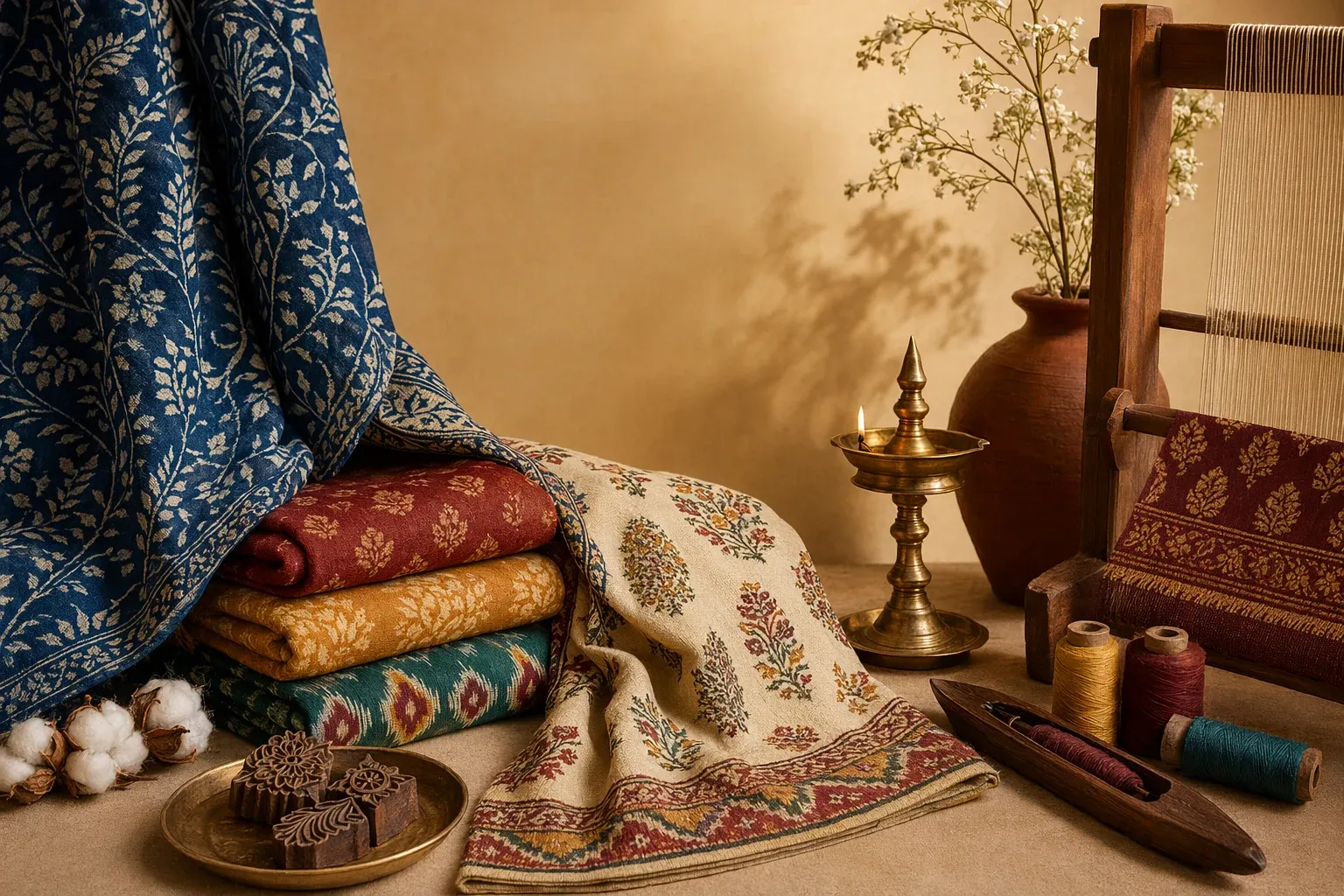
Indian textile patterns are not just decoration. They are a language of flowers, animals, borders, geometry, sacred forms, seasonal memory, and regional taste. A beginner may first notice colour and beauty, but with a little attention the cloth starts to reveal stories. A border may echo temple architecture. A peacock may suggest grace and celebration. A lotus may point toward purity, beauty, and auspiciousness. A small repeated flower may simply make daily cloth feel joyful.
Textile meanings are not always fixed like dictionary definitions. The same motif can change by region, community, period, and use. Still, some patterns appear so often across Indian cloth that they are worth learning first.
Paisley and mango forms
The paisley shape is one of the most recognisable textile motifs associated with Indian design. It is often described as a curved mango, leaf, seed, or teardrop form. In Indian contexts, mango-like shapes can suggest fertility, abundance, sweetness, and auspicious growth. In later global textile history, the shape travelled widely and became known by different names.
On saris, shawls, block prints, and brocades, paisley can appear as a large dramatic motif or a tiny repeating form. Beginners should notice whether the paisley is woven, printed, embroidered, or painted, because technique changes the feeling of the design.
Lotus motifs
The lotus is common in Indian art, temple symbolism, sculpture, painting, and textiles. It grows from water yet opens beautifully above the surface, so it often carries associations of purity, beauty, spiritual unfolding, and auspicious presence. In cloth, lotus forms may appear in borders, medallions, all-over patterns, or ceremonial pieces.
A lotus on a textile does not always mean the same thing in every setting. Sometimes it is devotional. Sometimes it is decorative. Sometimes it is inherited design vocabulary. The safest beginner approach is to recognise the association without overclaiming one single meaning.
Peacock designs
The peacock is loved for colour, elegance, monsoon memory, and royal beauty. In Indian textiles, peacocks appear in silk saris, embroidery, block prints, painted cloth, and borders. They may stand alone, face each other, hold vines, or blend into floral patterns.
Peacock motifs often give cloth a festive mood. In wedding textiles or ceremonial garments, they can add a sense of grandeur. In everyday printed cotton, they may simply bring playfulness and visual rhythm.
Elephant, horse, cow, and bird forms
Animal motifs are common across Indian textiles. Elephants can suggest strength, royalty, wisdom, procession, and auspiciousness. Horses may suggest movement, warriors, ceremony, or regional storytelling. Cows can carry pastoral and sacred associations in many Hindu contexts. Birds may suggest freedom, love, nature, or seasonal life.
Animal motifs should be read with care. Their meaning depends on placement, tradition, and use. A printed elephant on a cushion cover is not the same as an elephant in a temple textile or a wedding sari border. Context matters.
Temple borders and architectural forms
Many Indian saris and woven textiles use borders inspired by architecture. Temple borders may look like stepped triangles, gopuram-like shapes, or rhythmic edges. They frame the cloth and give it structure. In some silk traditions, the border is as important as the body of the sari.
Architectural patterns remind us that textile design often borrows from other arts. Stone, wood, painting, ritual objects, and jewellery can all influence cloth.
Flowers, vines, and gardens
Floral patterns are among the most common Indian textile designs. You may see small butis, large blossoms, climbing vines, garden layouts, sprays, or repeated leaves. Some floral designs reflect Mughal garden aesthetics, some local plant life, and some general decorative taste.
Flowers often make cloth feel graceful, fresh, and auspicious. In block prints, floral repeats may be light and airy. In brocade, they may feel rich and formal. In embroidery, they may feel intimate and handmade.
Geometry and repetition
Not every textile pattern is figurative. Dots, checks, stripes, waves, diamonds, grids, and zigzags are equally important. Bandhani uses tied dots to create fields of pattern. Leheriya uses wave-like lines. Ikat can create blurred geometry. Many tribal and regional textiles use strong linear forms.
Geometry gives rhythm to cloth. It can be simple, mathematical, playful, or symbolic. Even a plain check may carry regional familiarity because people associate it with everyday clothing from a place.
Colour as meaning
Colour also shapes textile meaning. Red is often linked with marriage, auspiciousness, and energy, though its use varies. Yellow can suggest turmeric, learning, spring, or sacred occasions in some settings. White may suggest purity, simplicity, mourning, or ritual depending on community and region. Green may suggest fertility, nature, or freshness. Black can be protective in some folk contexts and formal in others.
Beginners should avoid rigid colour rules. Indian colour meanings are rich but not uniform. A colour’s meaning depends on the garment, occasion, region, and community.
How to read a textile pattern respectfully
Start with observation before interpretation. What do you actually see: flower, bird, dot, wave, border, animal, or abstract form? Where does it appear: centre, border, pallu, sleeve, edge, or repeated field? How was it made: woven, printed, dyed, painted, or stitched? What is the cloth used for: daily wear, festival, wedding, home, temple, dance, or gift?
Then add meaning gently. Say “often associated with” rather than pretending every motif has one fixed secret. This keeps your reading respectful and accurate.
For related visual learning, Anjali, Dhyana, and Abhaya Mudra explains how symbolic forms work in sacred art. Warli art from Maharashtra is also useful for understanding how simple shapes can carry community memory.
The simple takeaway is that Indian textile patterns combine beauty with meaning. They may speak of nature, devotion, prosperity, protection, region, or celebration. The more carefully you look, the more the cloth becomes a visual conversation rather than just a surface design.