
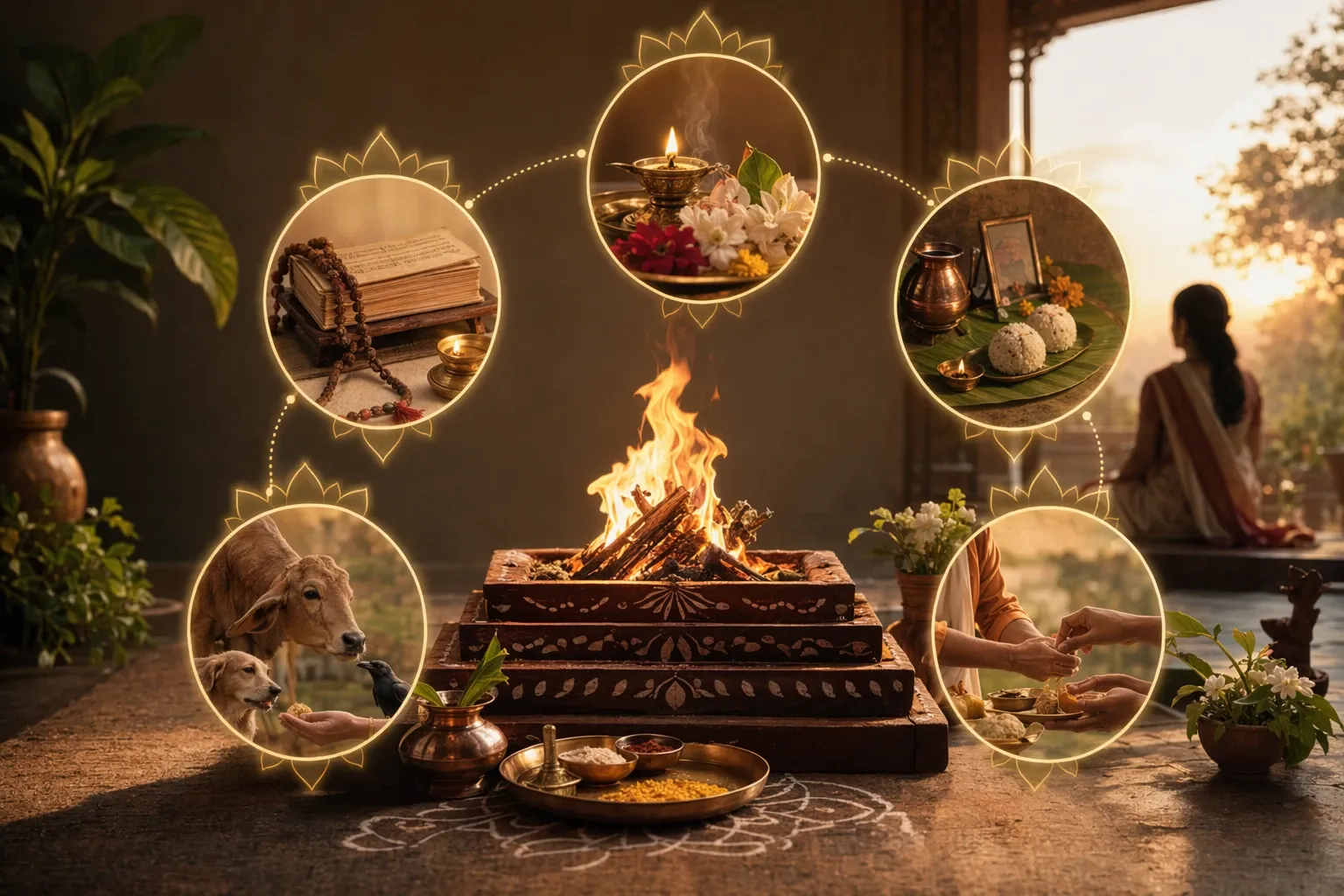
Pancha Maha Yajna describes five daily duties that remind a person to honour knowledge, ancestors, nature, guests, and other living beings. This guide keeps the idea simple for beginners while respecting the tradition behind it.
Simple answer
Pancha Maha Yajna describes five daily duties that remind a person to honour knowledge, ancestors, nature, guests, and other living beings.
In Hindu tradition, yajna usually means an offering made with reverence. Many yajnas use fire, mantras, and offerings, but the deeper idea is disciplined giving: offering something valuable with gratitude, responsibility, and a wish for harmony.
The important thing is to understand the idea clearly, not just memorize a translation.
For a wider foundation, read our Vedas beginner guide and this guide to Bhagavad Gita life lessons about duty, action, and inner discipline.
Why the idea matters
For young readers, yajna is easiest to understand as sacred reciprocity: humans receive from nature, ancestors, teachers, family, society, and the divine, so they respond through gratitude, restraint, service, and offering.
Yajna should not be reduced to smoke, spectacle, or quick results. Different families, regions, temples, and lineages may follow different procedures, so practical details are best learned from a trusted priest, elder, or tradition-aware guide.
The five are often explained as Brahma Yajna for learning and sacred knowledge, Deva Yajna for the divine and natural order, Pitri Yajna for ancestors, Bhuta Yajna for living beings, and Manushya or Atithi Yajna for guests and society.
The beauty of this idea is that yajna becomes daily responsibility. Study, gratitude, care for elders, kindness to animals, hospitality, and service all become forms of sacred offering.
What Pancha Maha Yajna means
The five are often explained as Brahma Yajna for learning and sacred knowledge, Deva Yajna for the divine and natural order, Pitri Yajna for ancestors, Bhuta Yajna for living beings, and Manushya or Atithi Yajna for guests and society.
For yajna topics, always separate symbol from superstition. Fire, offerings, mantras, and materials have meaning, but the heart of the practice is reverence, disciplined giving, and responsibility.
Deva yajna: gratitude to divine/nature
The beauty of this idea is that yajna becomes daily responsibility. Study, gratitude, care for elders, kindness to animals, hospitality, and service all become forms of sacred offering.
For yajna topics, always separate symbol from superstition. Fire, offerings, mantras, and materials have meaning, but the heart of the practice is reverence, disciplined giving, and responsibility.
Rishi/Brahma yajna: study and preserving knowledge
This part matters because “Rishi/Brahma yajna: study and preserving knowledge” is usually where beginners get confused. A simple way to read it is to connect the word with its purpose, its traditional context, and its everyday lesson.
For yajna topics, always separate symbol from superstition. Fire, offerings, mantras, and materials have meaning, but the heart of the practice is reverence, disciplined giving, and responsibility.
Pitri yajna: ancestors and family memory
This part matters because “Pitri yajna: ancestors and family memory” is usually where beginners get confused. A simple way to read it is to connect the word with its purpose, its traditional context, and its everyday lesson.
For yajna topics, always separate symbol from superstition. Fire, offerings, mantras, and materials have meaning, but the heart of the practice is reverence, disciplined giving, and responsibility.
Bhuta and Manushya yajna: ecology, compassion, hospitality
This part matters because “Bhuta and Manushya yajna: ecology, compassion, hospitality” is usually where beginners get confused. A simple way to read it is to connect the word with its purpose, its traditional context, and its everyday lesson.
For yajna topics, always separate symbol from superstition. Fire, offerings, mantras, and materials have meaning, but the heart of the practice is reverence, disciplined giving, and responsibility.
How a student can practice the spirit today
This part matters because “How a student can practice the spirit today” is usually where beginners get confused. A simple way to read it is to connect the word with its purpose, its traditional context, and its everyday lesson.
For yajna topics, always separate symbol from superstition. Fire, offerings, mantras, and materials have meaning, but the heart of the practice is reverence, disciplined giving, and responsibility.
Common misunderstandings
- Yajna is not only “putting things into fire”; it is a disciplined offering.
- Bigger ritual does not automatically mean deeper devotion.
- Regional words such as havan, homa, and homam need context.
- Sacred practice should never ignore health, safety, or environmental care.
Simple answers to common questions
What are the five Yajnas?
Pancha Maha Yajna describes five daily duties that remind a person to honour knowledge, ancestors, nature, guests, and other living beings.
What are the five types of Yajna?
Pancha Maha Yajna describes five daily duties that remind a person to honour knowledge, ancestors, nature, guests, and other living beings.
What are the Pancha yajnas?
Pancha Maha Yajna describes five daily duties that remind a person to honour knowledge, ancestors, nature, guests, and other living beings.
How many types of Yagya are there?
Yajna should not be reduced to smoke, spectacle, or quick results. Different families, regions, temples, and lineages may follow different procedures, so practical details are best learned from a trusted priest, elder, or tradition-aware guide.
The deeper meaning of daily duties
Pancha Maha Yajna is powerful because it expands duty beyond the self. It reminds a person that life is supported by knowledge, ancestors, nature, society, and other beings. In that sense, yajna is not only fire ritual; it is also gratitude expressed through action.
For a wider ethical foundation, read our guide to dharma in daily life. For sacred-text context, see what the Vedas are.
How a student can practise the spirit
A student can honour Rishi or Brahma yajna by studying sincerely and sharing knowledge. Pitri yajna can mean remembering family sacrifices. Bhuta yajna can mean feeding birds responsibly, reducing waste, or caring for animals. Manushya or Atithi yajna can mean hospitality, kindness, and helping someone without making it a social-media performance.